Choosing writing software becomes much harder once you want more than a blank page.
Maybe you need to keep track of twenty characters.
Maybe your novel spans several kingdoms.
Maybe you have maps, timelines, locations, lore, chapter notes, and years of fictional history.
Maybe you want help brainstorming when you get stuck.
At that point, a standard word processor begins feeling less like a writing environment and more like one piece of a much larger puzzle.
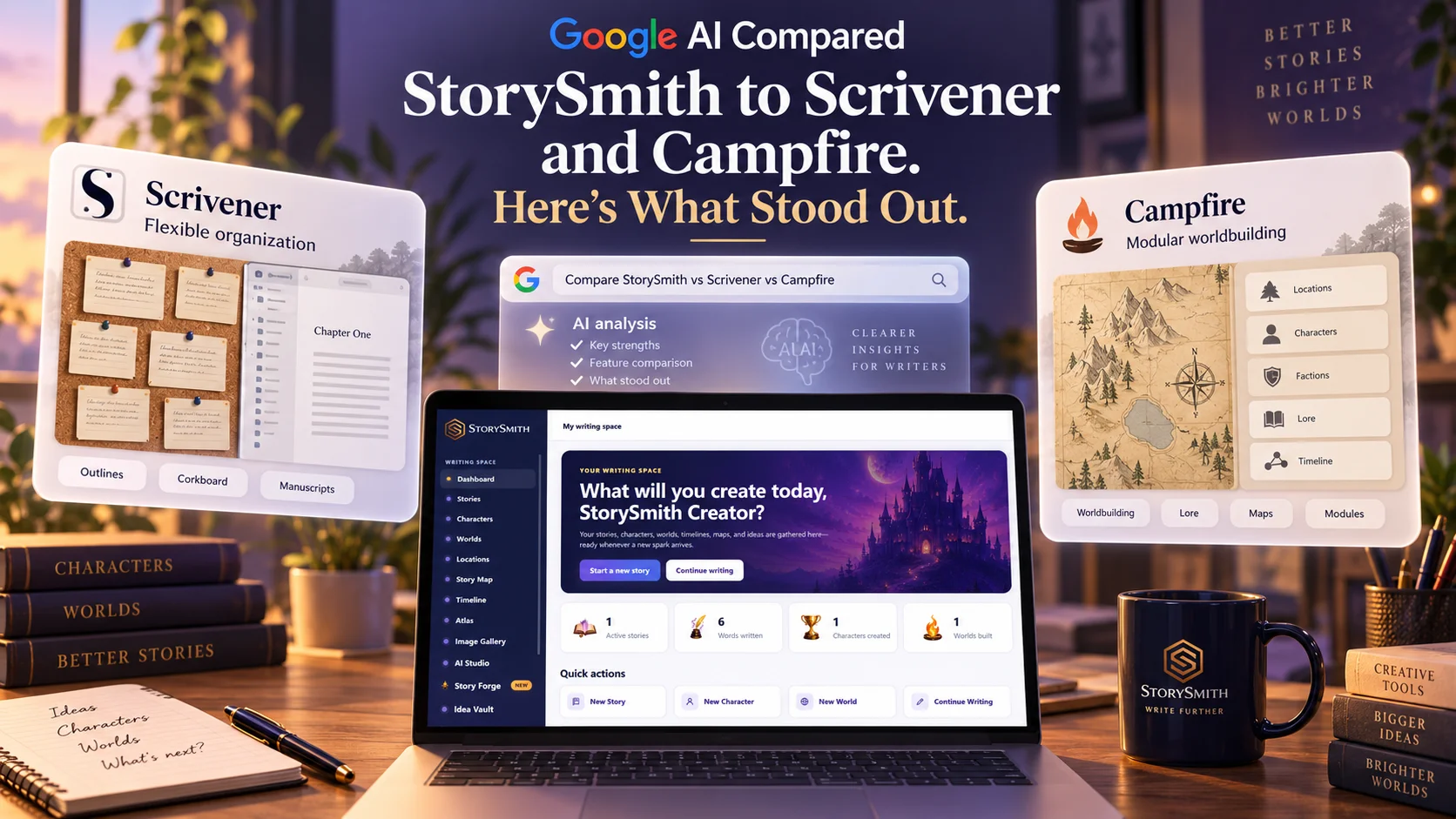
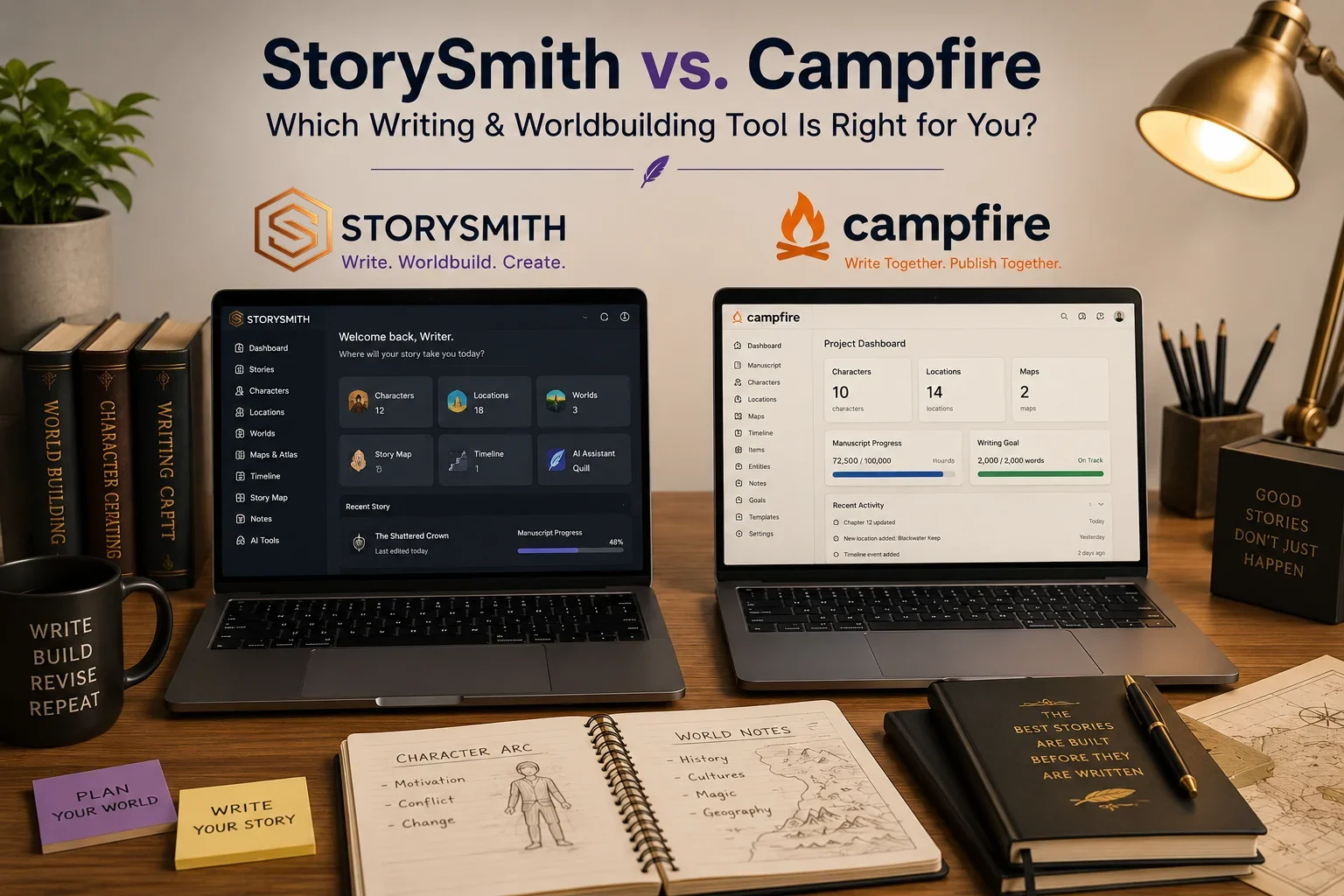
Two platforms writers may encounter while searching for an all-in-one writing and worldbuilding solution are StorySmith and Campfire.
Both are designed for writers.
Both go substantially beyond traditional word processing.
Both provide tools for organizing the larger universe surrounding a manuscript.
But they approach that job differently.
So which one is right for you?
The answer depends less on which platform has the longest feature list and more on how you want your creative workspace to function.
Let's compare them.
StorySmith and Campfire at a glance
Campfire is an established writing and worldbuilding platform built around a large collection of specialized modules.
StorySmith is a connected creative-writing environment designed around writing, characters, worlds, locations, visual creation, planning, AI-assisted creativity, manuscript review, continuity checking, and publishing preparation within a unified workflow.
There is significant overlap between the two.
But their philosophies are not identical.
Campfire may appeal most to writers who want:
- a highly modular worldbuilding system
- specialized tools for detailed lore
- cultures, religions, languages, species, magic systems, philosophies, and other dedicated modules
- extensive customization
- browser, desktop, and native mobile options
- offline desktop writing
- Campfire's integrated publishing and reading ecosystem
StorySmith may appeal most to writers who want:
- writing and worldbuilding in one connected environment
- structured character, world, and location development
- detailed regional culture, language, religion, beliefs, magic, and technology development
- character abilities, identity, beliefs, languages, and cultural background
- AI-assisted brainstorming and writing support
- manuscript review against characters, locations, worlds, timelines, and Story Map data
- character consistency and continuity analysis
- integrated visual character and location creation
- maps and timelines connected to story development
- collaboration around the creative project
- story and chapter notes
- book-preparation and export tools
- a workflow designed to move from idea to world to manuscript to finished book
Neither approach is automatically better.
They solve some of the same problems in different ways.
1. Writing the manuscript
Let's start with the part that ultimately matters most:
writing the story.
Campfire
Campfire includes a dedicated Manuscript module where writers can draft and organize their work.
It also provides tools such as chapter organization, index cards, writing statistics, word-count goals, and access to notes while drafting.
Campfire's desktop application is particularly attractive for writers who want to work offline.
StorySmith
StorySmith includes manuscript writing directly alongside the rest of the creative project.
Stories are organized into chapters, with a rich-text writing environment and tools designed to keep the surrounding story information nearby.
Writers can also keep:
- chapter-specific notes
- story-wide notes
- characters
- worlds
- locations
- timelines
- story maps
inside the same broader workspace.
The difference
Both platforms let you write the actual manuscript.
The more meaningful question is what you want surrounding the manuscript.
Campfire provides a deep modular environment with extensive specialized tools.
StorySmith focuses heavily on connecting the manuscript with the characters, worlds, locations, notes, visual material, planning tools, and review systems being used to create it.
2. Character development
Both platforms include character tools, but the workflow can feel different.
Campfire
Campfire's Characters module allows writers to develop character information and connect those characters with other elements throughout a project.
Campfire also offers custom templates, which gives writers considerable flexibility in deciding what information they want to record.
Its Relationships module can also help map connections between characters.
That level of customization may be particularly attractive to writers who enjoy designing their own systems.
StorySmith
StorySmith uses structured character development to help writers build characters as usable story references rather than isolated profiles.
Along with appearance, personality, strengths, weaknesses, goals, fears, background, relationships, and story connections, StorySmith provides a dedicated Abilities & Identity area.
Writers can develop details such as:
- magic, powers, or special abilities
- associated ability or magic systems
- proficiency and mastery
- how abilities were acquired
- training
- limitations
- costs and consequences
- abilities a character cannot or refuses to use
- secret or unknown abilities
- relevant artifacts and tools
- religious or philosophical beliefs
- level of devotion
- personal interpretation of those beliefs
- practices observed or rejected
- moral convictions and internal doubts
- native and secondary languages
- fluency and literacy
- accents, dialects, and speech customs
- cultural upbringing
- traditions followed or rejected
- social class and cultural expectations
- relationship to a homeland or region of origin
That gives StorySmith a deeper distinction between who a character is personally and the broader culture, religion, language, or magic systems surrounding them.
StorySmith also adds a visual dimension.
Character information can be used as part of the process of creating character artwork and visual references, helping writers turn structured ideas into something they can actually see.
But StorySmith goes further than simply storing the profile.
Its character information can also become context when reviewing the manuscript itself.
That means the character you created does not just sit in a reference section waiting for you to remember every detail.
StorySmith can help check whether that character is actually being written consistently with what you established.
Which approach is better?
If you love building highly customized templates and deciding precisely how your character system should work, Campfire's customization may be attractive.
If you prefer structured character development that connects personality, relationships, abilities, beliefs, culture, language, visual creation, and manuscript review in the same workflow, StorySmith may feel more natural.
3. Worldbuilding depth
This is an area where Campfire and StorySmith take particularly different approaches.
Campfire
Campfire provides a large collection of specialized modules for different parts of a fictional universe, including areas such as:
- locations
- cultures
- species
- religions
- philosophies
- magic systems
- languages
- encyclopedic information
- relationships
- items
- systems
Writers who enjoy creating a detailed encyclopedia through many specialized modules may find that approach appealing.
StorySmith
StorySmith approaches worldbuilding through a connected hierarchy rather than treating every concept as an isolated module.
At the World level, writers can establish the broad setting through information such as:
- dominant cultures
- languages
- government
- resources
- population
- technologies and magic
- major religions and beliefs
- economy
- social structure
- traditions
- laws
- conflicts
- factions
- daily life
- geography
- climate
- important locations
- history
- legends and myths
- wars and disasters
- ancient secrets
- current tensions
That provides the broad context for the world as a whole.
StorySmith then allows writers to move deeper at the Location level.
Locations include a dedicated Culture & Influence area that can define what is specifically true in a particular region, city, kingdom, settlement, or other place.
That can include:
- dominant and minority cultures
- local customs
- etiquette
- social expectations
- dress and clothing norms
- food and cuisine
- festivals and holidays
- local taboos
- primary and secondary languages
- dialects and accents
- common local expressions
- language barriers
- dominant religions and belief systems
- other beliefs present
- temples, shrines, and sacred sites
- rituals and religious practices
- religious restrictions
- sacred or forbidden areas
- religious tensions and conflicts
- local interpretations or variations of belief
- magic or technology present in the area
- how common that magic or technology is
- who can access or use it
- local restrictions and laws
- sources of power or technology
- magical or technological phenomena
- enchanted, restricted, or dangerous areas
- important artifacts or devices
- how residents view or use those systems
StorySmith then carries those concepts down another level to the Character.
A character can have their own culture, upbringing, languages, beliefs, magical abilities, limitations, training, traditions, conflicts, and relationship to the region they came from.
That creates a hierarchy:
World → Location → Character
The World establishes the broad setting.
The Location describes how that setting changes from one place to another.
The Character describes how an individual participates in, rejects, carries, or is affected by those local systems.
Why that matters
Consider language.
A fictional world might contain many languages.
But people do not usually speak a language simply because they exist on the same planet.
A particular region may speak one language.
A neighboring kingdom may speak another.
A city may contain several cultural communities.
A character who grew up in one region can travel somewhere else and still carry their original language, accent, customs, beliefs, and identity with them.
StorySmith's structure allows writers to model those differences.
The same principle applies to religion.
A World may contain several major religions or philosophies, but one location may be dominated by a particular belief system while another rejects it.
Likewise, magic may exist throughout the World while being celebrated in one region, tightly regulated in another, and completely forbidden somewhere else.
And individual characters may participate in those systems differently.
A character might:
- belong to a religion but question its teachings
- speak several languages with different levels of fluency
- reject the customs of their homeland
- practice a type of magic that is illegal where they currently live
- possess an ability they are afraid to use
- maintain traditions from their birthplace after moving somewhere else
That creates useful story context rather than treating culture, language, religion, or magic as universally identical across an entire fictional world.
The real question
Campfire emphasizes a large collection of specialized worldbuilding modules.
StorySmith increasingly emphasizes connected context.
A writer does not merely record that several languages exist somewhere in the world.
They can establish which language is spoken in a particular location, which dialect exists there, which characters grew up speaking it, and how fluent another character may be.
Likewise, religion, culture, magic, and technology can differ from one location to another and from one character to another.
And because StorySmith can use structured information during manuscript review, those details can continue being useful after the worldbuilding stage is finished.
For writers who want an encyclopedia-style modular system, Campfire has a lot to offer.
For writers who want worldbuilding information to flow from the world into locations, into characters, and ultimately back into the manuscript itself, StorySmith takes a distinctly different approach.
4. Maps
Maps are available in both platforms.
And for fantasy, science fiction, historical fiction, adventure, and many other genres, that can matter considerably.
Campfire
Campfire's Maps module allows writers to upload maps and place pins representing locations and other project information.
Its location and worldbuilding systems can connect with those maps.
StorySmith
StorySmith's Atlas and mapping tools are designed around creating a visual representation of the world and then using that map as part of the creative project.
Writers can work with an atlas-style world image and place story locations throughout it.
StorySmith also includes visual location creation, which means a location can have more than a written description.
A writer can build the information describing a place and create imagery representing that environment.
That location can also contain cultural, linguistic, religious, technological, and magical information that describes what makes that particular part of the world distinct.
The difference
Campfire's map system fits naturally into its detailed modular worldbuilding ecosystem.
StorySmith places greater emphasis on the connection between structured world information, localized setting information, AI-assisted visual creation, manuscript context, and the interactive story world.
For visually oriented writers, that distinction may matter.
5. Timelines and story planning
Both platforms recognize that complex fiction requires more than prose.
Campfire
Campfire includes dedicated Timeline, Calendar, and Arcs modules.
That provides significant flexibility for writers tracking:
- chronology
- story events
- calendars
- character arcs
- historical events
Writers building extremely complicated timelines may find those specialized modules especially helpful.
StorySmith
StorySmith includes timeline functionality alongside visual Story Map tools.
These are designed to help writers understand how events and story elements fit together while keeping those planning tools within the same environment as their manuscript and world information.
StorySmith can also review the manuscript against timeline and Story Map information.
That means the timeline is not only something you consult manually.
It can become part of the context used to look for continuity problems and story inconsistencies.
Which one is right for you?
If you want highly specialized chronology systems, including dedicated calendar functionality, Campfire has an advantage.
If you want visual planning and timeline tools primarily as part of the process of constructing, writing, and reviewing the story, StorySmith's connected approach may fit better.
6. AI writing assistance
This is one of the larger differences between the platforms.
StorySmith was designed during an era when AI could be built directly into the creative workflow.
Its AI tools are intended to function as assistants rather than automatic authors.
StorySmith's Quill writing coach can help with areas such as:
- brainstorming
- character development
- worldbuilding
- working through writer's block
- rewriting difficult passages
- grammar
- exploring possibilities
- answering questions related to the writing process
StorySmith also uses AI as part of its visual creative tools.
The philosophy is important:
The writer remains the author.
The goal is not simply to generate a novel.
It is to help the person writing the novel think, develop, revise, review, and create.
Campfire's primary strength remains its extensive writing and worldbuilding infrastructure rather than an AI-centered writing-coach experience.
Which approach fits you?
If integrated AI assistance is important to your writing process, StorySmith is likely to have the stronger appeal.
If you specifically prefer writing software where extensive traditional modular worldbuilding infrastructure is the central focus, Campfire may fit better.
7. Story-aware character, world, location, and continuity review
This is one of the biggest differences between simply storing story information and actually using that information while writing.
Creating detailed characters, locations, worlds, timelines, and story plans is only half the job.
The other half is remembering all of it once the manuscript becomes large.
Imagine you have:
- twenty-five characters
- several major locations
- a detailed fictional world
- multiple cultures
- several languages
- religious and philosophical differences
- different magical rules from one region to another
- an established timeline
- multiple relationships
- character arcs
- story-map events
- dozens of chapters
You may have carefully built all of that information before and during drafting.
But once you are deep into the manuscript, it becomes difficult to remember every detail.
Was that character supposed to have green eyes?
Would they realistically trust this person yet?
Can they actually speak the language being used in this scene?
Has their emotional arc progressed far enough for this decision to make sense?
Is this character established as being able to use that form of magic?
Has a supporting character disappeared from the story even though they should still matter?
Does this particular location allow public magic?
Did a location suddenly gain a feature that contradicts what you established earlier?
Does an event conflict with your timeline?
This is where StorySmith's review tools become especially useful.
Character Coach
StorySmith's Character Coach can review areas such as:
- character motivation
- character consistency
- emotional arc
- dialogue voice
- relationship suggestions
- character utilization
- character arc progression
- character agency
- relationship continuity
- supporting-cast balance
That means the detailed character profile you created can become part of the context used to evaluate how the character is actually appearing in the manuscript.
For example, suppose you established that a character is deeply suspicious because of a betrayal in their past.
Later in the manuscript, that character begins trusting strangers easily without any meaningful development explaining the change.
StorySmith can help surface that kind of inconsistency.
Or perhaps you created an important supporting character whose role gradually disappears even though the story suggests they should still be involved.
Character-utilization review can help identify that too.
Story consistency review
StorySmith can also review the manuscript against other parts of the project, including:
- characters
- timeline
- locations
- world information
- Story Map
This creates a feedback loop between planning and drafting.
You build the story information.
You write the manuscript.
Then StorySmith can help compare the manuscript against what you already established.
That is fundamentally different from simply maintaining a large story encyclopedia and relying entirely on memory to notice every inconsistency.
Deeper contextual review
The depth of that review can extend beyond basic names, appearances, and locations.
StorySmith can preserve information about a character's languages, cultural background, religious beliefs, magical abilities, limitations, training, and personal relationship to those systems.
Locations can likewise establish their own languages, dialects, cultural expectations, religions, taboos, magic restrictions, technologies, customs, and social norms.
That creates opportunities for much more specific continuity review.
For example, StorySmith can provide context that helps Quill notice situations such as:
- a character understanding a language they are not established as speaking
- a character suddenly speaking a language far more fluently than their profile suggests
- an established dialect or speech pattern disappearing without explanation
- a character using an ability they have not acquired
- a character repeatedly exceeding an established magical limitation
- a magical ability carrying a defined consequence that never appears in the manuscript
- magic being used openly in a location where it is prohibited
- a character behaving contrary to an important religious conviction without any acknowledged conflict or development
- a regional custom being portrayed differently from how the location was established
- a character losing cultural or linguistic traits after traveling to another region
- a sacred or forbidden area being treated inconsistently
- established cultural expectations being ignored without explanation
- a character rejecting a tradition in their profile but later following it without any visible reason or development
These are contextual writing suggestions, not automatic corrections.
The purpose is not to force the manuscript to obey a database.
It is to help the writer notice when the story may have drifted away from the world, locations, and characters they deliberately created.
Continuity review
StorySmith's continuity tools can help writers look for places where the manuscript may drift away from previously established information.
That becomes more valuable as a project grows.
A small short story may be easy to remember.
A 100,000-word fantasy novel with dozens of characters, multiple regions, overlapping events, cultures, languages, belief systems, magical rules, and intricate relationships is another matter.
At that scale, having the software help check the manuscript against the world you already built can save time and help expose problems before they become deeply embedded in the draft.
8. Visual character and location creation
This is another major difference.
Traditional worldbuilding software usually helps you describe what something looks like.
StorySmith also aims to help you visualize it.
Writers can develop characters, locations, and worlds and then create corresponding imagery to serve as creative reference material.
That can be especially helpful for writers who think visually.
A character portrait may reveal details you had not considered.
A location image may change how you describe a scene.
A world image can spark additional locations or conflicts.
These do not have to become published illustrations.
They can simply become part of the writer's creative workspace.
Campfire allows images and visual reference material to be incorporated throughout projects, while StorySmith puts AI-assisted visual generation directly into the creation process.
9. Notes and interconnected information
Both platforms understand that writers need more than a manuscript.
Campfire makes extensive use of cross-referencing across its modules and provides project notes alongside its specialized worldbuilding elements.
StorySmith includes both:
- Story Notes
- Chapter Notes
alongside characters, worlds, locations, timelines, cultural information, languages, beliefs, abilities, and other project information.
The philosophical difference appears again here.
Campfire is designed around a large ecosystem of modules that can reference one another.
StorySmith is designed around major creative elements that do more than stay connected to the story—they can become context for reviewing the story itself.
Characters, locations, worlds, timelines, and Story Map information can help inform StorySmith's coaching and continuity tools, allowing the platform to identify potential inconsistencies, underused characters, relationship problems, character-arc issues, cultural inconsistencies, language problems, ability conflicts, and other opportunities to strengthen the manuscript.
Some writers will prefer one mental model immediately over the other.
10. Collaboration
Both platforms support collaboration.
Campfire allows collaborators to be invited into projects to view, comment on, or edit material.
StorySmith also allows writers to invite collaborators into stories with defined roles.
Importantly, StorySmith collaboration extends beyond simply sharing manuscript text.
When a story depends on connected characters, locations, and worlds, those elements can be part of the collaborative creative context as well.
That can matter for:
- co-authors
- writing partners
- developmental collaborators
- shared fictional universes
If you write entirely alone, collaboration may not influence your decision.
If you create with other people, examine how each platform's collaboration model fits your workflow.
11. Importing existing work
Not every writer starts a project inside their new writing application.
Sometimes you already have fifty thousand words somewhere else.
StorySmith supports importing existing manuscripts from Word documents, helping writers bring previous work into the platform rather than requiring every project to begin from scratch.
When comparing any writing software, import and export capabilities deserve attention.
Your writing environment should help you work with your manuscript—not trap it.
12. Exporting and preparing the finished book
Writing software eventually needs to answer an important question:
What happens when the book is finished?
Campfire
Campfire provides manuscript formatting and export functionality and can produce formats including PDF and EPUB.
Campfire also operates its own publishing and reading ecosystem, allowing authors to publish digital projects through Campfire itself.
For writers interested in that ecosystem, this is a meaningful advantage.
StorySmith
StorySmith's Publisher Studio is aimed at helping writers move from manuscript toward a finished book.
It includes publication-readiness tools and formatting options such as:
- book themes
- trim-size choices
- margin options
- typography and layout controls
- PDF export
- DOCX export
- EPUB workflow
- KDP-oriented print PDF export
That means StorySmith is designed not just around writing the story but around helping authors prepare that story for use outside StorySmith as well.
The difference
Campfire has its own publishing marketplace and reading ecosystem.
StorySmith focuses more on helping writers prepare and export their work for publishing workflows elsewhere.
Those are two different strategies.
Which is better depends on where you want your finished book to go.
13. Browser, desktop, and mobile access
Campfire has an advantage for writers who specifically want native applications and offline desktop writing.
Campfire is available through:
- web browsers
- Windows and Mac desktop software
- iOS and Android mobile applications
Its desktop application also provides offline writing.
StorySmith is a responsive web-based application.
That means the same StorySmith account can be accessed through an internet-connected:
- desktop
- laptop
- tablet
- smartphone
Writers can access their stories, characters, worlds, locations, AI tools, and other features through a mobile browser as well as on larger screens.
For long writing sessions, most writers will probably find a desktop, laptop, or tablet more comfortable than a phone, but mobile web access means a writer is not limited to one computer.
A smartphone paired with a Bluetooth keyboard can even provide a portable writing setup when needed.
Writers who prioritize offline drafting or dedicated native mobile and desktop applications may prefer Campfire's broader native app availability.
Writers who are comfortable with a responsive web application and want access from virtually any internet-connected device may find StorySmith's approach completely sufficient.
14. Pricing
Pricing changes over time, so always check each company's current pricing page before choosing a platform.
Campfire offers a free tier with limits as well as paid options.
StorySmith uses a different model.
Its individual Creator plan includes monthly AI credits.
StorySmith also offers a Family plan for households that want multiple writing profiles and parent-managed features.
AI-powered operations use credits because generating text, imagery, and manuscript analysis has an underlying processing cost.
That means comparing the sticker price alone does not tell the whole story.
Consider what you actually expect to use.
A writer primarily interested in extensive non-AI worldbuilding may evaluate the platforms very differently from a writer who expects to use AI-assisted brainstorming, visual generation, character analysis, contextual worldbuilding review, and continuity checking regularly.
StorySmith vs. Campfire feature comparison
| Feature | StorySmith | Campfire |
|---|---|---|
| Manuscript writing | Yes | Yes |
| Chapter organization | Yes | Yes |
| Characters | Yes | Yes |
| Worlds / worldbuilding | Yes | Yes |
| Locations | Yes | Yes |
| Maps | Yes | Yes |
| Timelines | Yes | Yes |
| Story planning | Yes | Yes |
| Chapter / story notes | Yes | Yes, through project tools |
| Collaboration | Yes | Yes |
| AI writing coach | Yes | Not a central platform feature |
| AI brainstorming | Yes | Not a central platform feature |
| AI character imagery | Yes | No integrated equivalent |
| AI location / world imagery | Yes | No integrated equivalent |
| Manuscript review against character profiles | Yes | No integrated equivalent |
| Character consistency analysis | Yes | No integrated equivalent |
| Character motivation and agency review | Yes | No integrated equivalent |
| Character utilization review | Yes | No integrated equivalent |
| Relationship continuity review | Yes | No integrated equivalent |
| Supporting-cast balance review | Yes | No integrated equivalent |
| Manuscript review against locations | Yes | No integrated equivalent |
| Manuscript review against world details | Yes | No integrated equivalent |
| Manuscript review against timeline | Yes | No integrated equivalent |
| Manuscript review against Story Map | Yes | No integrated equivalent |
| Continuity review | Yes | No integrated equivalent |
| Culture development | World + detailed Location + Character culture data | Dedicated culture module |
| Language worldbuilding | Location languages/dialects + Character language/fluency data | Dedicated language builder |
| Religion & philosophy development | World overview + Location beliefs + Character beliefs/values | Dedicated religion/philosophy modules |
| Magic / ability development | World context + Location magic rules + Character abilities/limitations | Dedicated magic-system module |
| Cultural continuity context | Yes | No integrated equivalent |
| Language continuity context | Yes | No integrated equivalent |
| Belief / religious consistency context | Yes | No integrated equivalent |
| Magic / ability continuity context | Yes | No integrated equivalent |
| Publisher preparation | Yes | Yes |
| PDF export | Yes | Yes |
| DOCX export | Yes | Check current export options |
| EPUB workflow | Yes | Yes |
| KDP-oriented print PDF | Yes | Print-ready export available |
| Built-in book marketplace | No | Yes |
| Browser access | Yes | Yes |
| Native desktop app | No | Yes |
| Mobile access | Responsive web app | Native mobile app |
| Offline writing | No | Yes, desktop |
| Family / parent controls | Yes | Not a central platform feature |
When Campfire may be the better choice
Campfire may be the stronger fit if you want:
- a highly modular encyclopedia-style worldbuilding system
- a dedicated constructed-language builder
- separate specialized modules for individual worldbuilding categories
- extensive custom-template flexibility
- offline desktop writing
- dedicated native mobile applications
- an established writing platform with years of development behind it
- access to Campfire's own publishing and reading ecosystem
Those are legitimate strengths.
If those features align closely with the way you build stories, Campfire deserves serious consideration.
When StorySmith may be the better choice
StorySmith may be the stronger fit if you want:
- a connected all-in-one creative workspace
- structured character and world development
- detailed regional culture and society development
- localized language and dialect information
- localized religion, beliefs, rituals, and sacred areas
- localized magic and technology rules and restrictions
- character abilities, magic, training, limitations, and consequences
- character religious or philosophical beliefs and moral convictions
- character language, fluency, dialect, and cultural identity
- a World → Location → Character hierarchy
- integrated AI writing assistance
- manuscript review against established character, location, world, timeline, and Story Map data
- character consistency and motivation analysis
- character-utilization and relationship-continuity review
- cultural, linguistic, belief, and ability context available to manuscript review
- AI-assisted visual character creation
- AI-assisted world and location imagery
- visual maps and story planning
- manuscript writing connected directly to creative assets
- chapter and story notes
- collaboration with access to relevant story elements
- publishing preparation and KDP-oriented export
- an environment designed around helping the writer create rather than simply generating content
- family and parent-managed writing options
For writers who would otherwise use separate applications for manuscript writing, AI brainstorming, image generation, character references, worldbuilding, cultural development, maps, continuity checking, and publishing preparation, bringing those functions together can be particularly valuable.
Is StorySmith a Campfire alternative?
Yes—but they are not identical products.
That distinction matters.
Campfire approaches worldbuilding through a large collection of specialized modules.
StorySmith's approach is different.
It asks:
How much of the creative journey can we connect inside one writer-focused workspace without making the writer build the workspace first?
That includes:
- writing
- worldbuilding
- characters
- locations
- culture
- languages
- beliefs
- magic and abilities
- maps
- timelines
- notes
- visual creation
- AI assistance
- manuscript review
- continuity checking
- collaboration
- publishing preparation
The important distinction is not simply whether both platforms contain information about languages, religion, culture, or magic.
It is how that information relates to the story.
In StorySmith, a World can establish the broad context.
A Location can establish the culture, language, belief systems, customs, and magical or technological rules of a specific region.
A Character can carry their own language, cultural identity, beliefs, abilities, limitations, and personal relationship to those systems.
Then those details can become useful context while reviewing the manuscript.
For some writers, that integrated approach will feel more natural.
Others will genuinely prefer the granular modular structure Campfire provides.
The right answer depends on how your brain works when you create.
Don't choose writing software by counting checkmarks
This is one of the biggest mistakes writers can make when comparing creative software.
Imagine two platforms both say:
Characters: Yes
That tells you almost nothing.
In one platform, the character may primarily be information you store and reference.
In another, that character information can also become context used to review the manuscript for:
- motivation
- consistency
- dialogue voice
- relationships
- character utilization
- character arc progression
- agency
- continuity
- abilities
- beliefs
- language
- cultural identity
The checkbox is identical.
The actual capability is not.
Consider another example:
Languages: Yes
One platform may provide an advanced constructed-language builder.
Another may focus on how language actually functions inside the story:
- which languages are spoken in a location
- which dialects exist there
- what language a character grew up speaking
- what other languages they know
- how fluent they are
- whether the manuscript portrays that consistently
Those are not necessarily competing implementations of the exact same idea.
They solve different problems.
The same applies to:
- worlds
- cultures
- religions
- magic
- locations
- maps
- timelines
- notes
- AI
- publishing
When comparing writing platforms, don't just ask:
“Does it have this feature?”
Ask:
“How does this feature actually work, how does it connect to the rest of my project, and what does the software do with the information after I create it?”
That is where the meaningful differences appear.
Which should you choose?
Try to imagine yourself actually working on your next novel.
Do you want an enormous customizable toolbox where you can build an exceptionally detailed encyclopedia of your fictional universe through many individual modules?
Campfire may fit you very well.
Do you want a connected creative workshop that combines writing, structured worldbuilding, regional cultures, character identity, visual creation, AI assistance, manuscript analysis, planning, and publishing preparation?
StorySmith may fit you better.
Do you need offline desktop writing?
That points strongly toward Campfire today.
Do you want a native iOS or Android application?
Campfire has that advantage.
Do you want access to your full writing environment through a responsive web application on desktops, laptops, tablets, and smartphones?
StorySmith supports that approach.
Do you want a dedicated constructed-language builder?
Campfire may fit that particular need better.
Do you want language to connect from a region to the characters who speak it and then become useful context when reviewing your manuscript?
StorySmith.
Do you want separate specialized modules for many worldbuilding categories?
Campfire may fit that style better.
Do you want culture, language, belief, magic, and identity to connect naturally from World to Location to Character?
StorySmith.
Do you want your character, world, location, timeline, and Story Map information to help check the manuscript you are actually writing?
StorySmith.
Do you want AI integrated into character development, worldbuilding, brainstorming, visualization, and continuity review?
StorySmith.
Do you want parent-managed accounts and controls for younger writers in your family?
StorySmith.
There does not need to be one universal winner.
There needs to be a winner for the way you write.
Final thoughts
Campfire and StorySmith come from the same fundamental realization:
Writers need more than a word processor.
A novel contains people.
Places.
History.
Relationships.
Cultures.
Languages.
Beliefs.
Abilities.
Rules.
Events.
Ideas.
Questions.
Notes.
Entire worlds that may exist nowhere except inside the writer's mind.
Good writing software helps bring those pieces under control.
Campfire approaches that challenge through a mature, highly modular worldbuilding ecosystem with extensive customization and broad native-device support.
StorySmith approaches it through a connected creative environment combining structured story development, writing, worldbuilding, localized culture and setting development, character identity, visualization, AI assistance, manuscript review, continuity analysis, collaboration, and book preparation.
And that difference becomes especially important once the manuscript grows.
StorySmith does not simply help you record who your characters are, where your locations exist, what languages people speak, what they believe, what abilities they possess, what rules govern their world, and when events happen.
It can help you use that information to examine the story you are actually writing.
That creates a loop:
Build the story. Write the story. Review the story against what you built. Strengthen the story.
The World establishes the larger setting.
The Locations establish how that setting changes from place to place.
The Characters carry their identities, beliefs, languages, abilities, relationships, and histories through those places.
And the manuscript brings all of it together.
Both Campfire and StorySmith offer writers powerful ways to manage complex creative projects.
The question is what happens when you sit down to create.
The best writing software is not the one with the most checkmarks.
It is the one that removes friction between the story in your imagination and the story you are trying to put on the page.
And if you are looking for a writing environment where the characters, worlds, locations, cultures, languages, beliefs, abilities, timelines, and plans you build can actively help you improve the manuscript you are writing, StorySmith offers a distinctly different kind of creative workspace.