When you build a writing platform from the ground up, you spend a lot of time thinking about what makes it different.
You know the features.
You know the workflow.
You know why certain things were built the way they were.
But there is another question that is harder to answer from inside the product:
How does the outside world understand it?
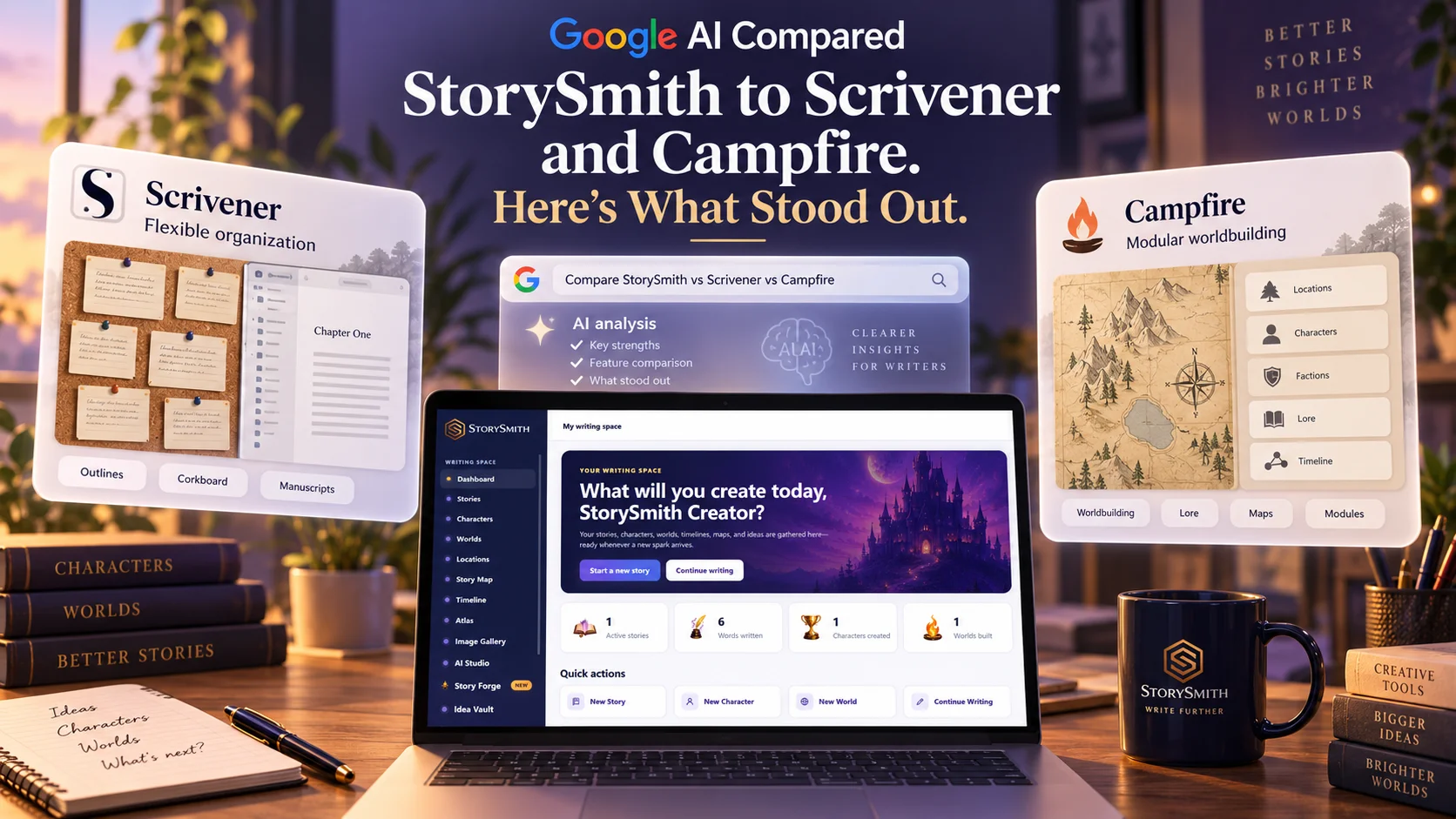
Recently, I got curious and started asking Google’s AI to compare StorySmith with a few established writing platforms.
I wasn’t looking for praise.
I wasn’t trying to prove that one platform was universally better than another.
I wanted to see whether Google actually understood what StorySmith is, how it differs from other writing tools, and what kind of writer it seemed to think each platform was best for.
The results were interesting because the same pattern kept appearing.
When Google’s AI compared StorySmith with Campfire, it consistently described the difference as one of connected workflow versus modular worldbuilding.
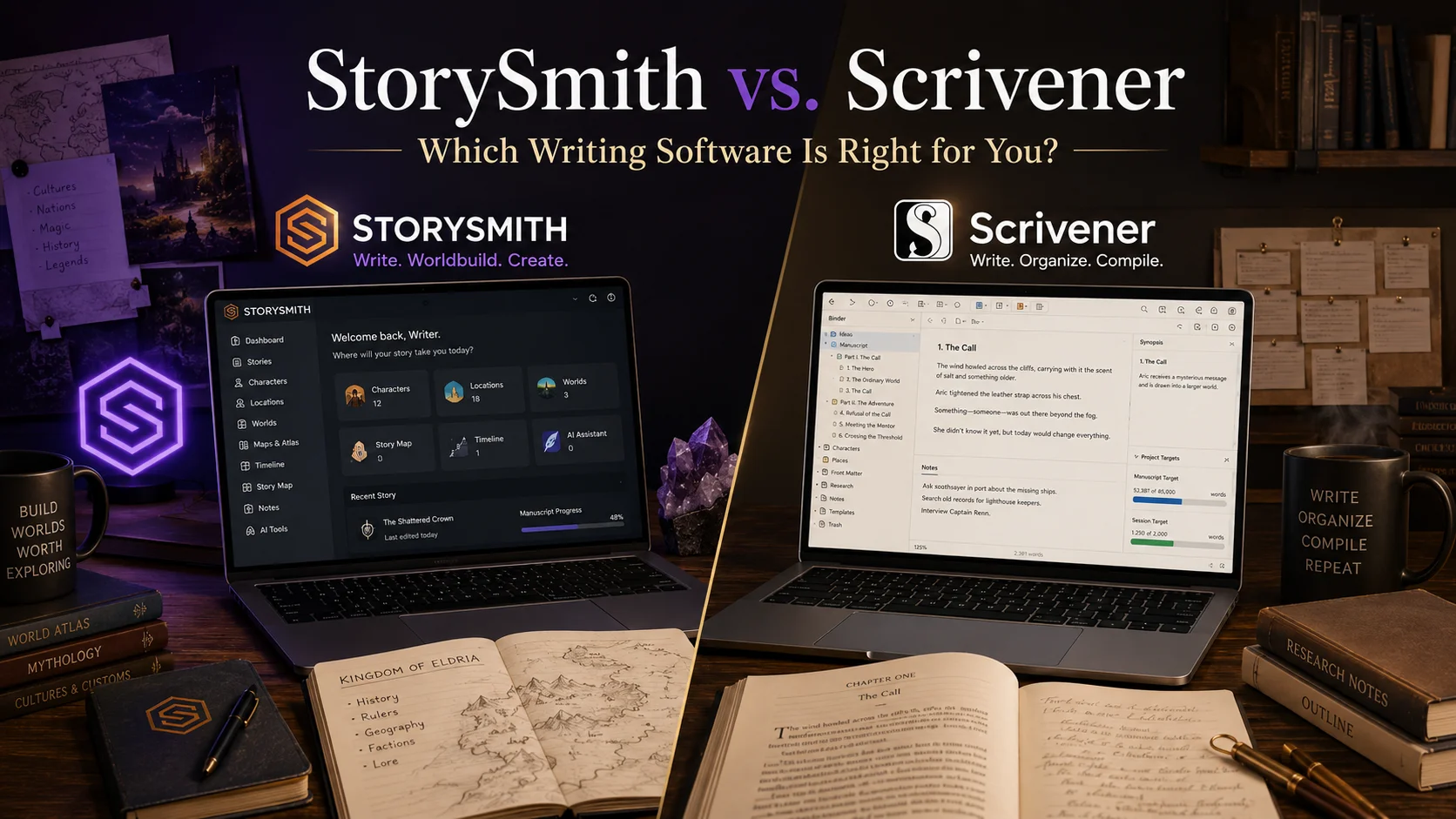
When it compared StorySmith with Scrivener, it described the difference as structured story development versus highly customizable manuscript organization.
And when I pushed the comparison further and asked which platform it would choose for fiction writing, Google’s AI repeatedly gave StorySmith an edge for writers who wanted a more connected, modern, story-first workflow.
That does not mean Google has issued some official endorsement of StorySmith.
AI-generated search results can vary based on query wording, device, timing, source selection, and other factors.
But the consistency of the reasoning was still worth looking at.
What Google’s AI said about StorySmith vs. Campfire
When comparing StorySmith and Campfire, Google’s AI described both as comprehensive fiction-writing ecosystems with strong worldbuilding capabilities.
But it drew a clear distinction between how the two platforms organize creative information.
Campfire was described as a more modular, encyclopedia-style system built around highly specialized worldbuilding modules.
StorySmith was described as a more connected workflow where information moves through the creative project rather than sitting in isolated modules.
That distinction matters.
Campfire has a lot to offer writers who love building extremely detailed fictional encyclopedias.
Its modular approach can support things such as:
cultures
languages
religions
species
magic systems
calendars
philosophies
relationships
timelines
specialized worldbuilding structures
For a writer who wants to build a deeply customized lore database, that can be very appealing.
StorySmith takes a different approach.
Instead of separating every idea into its own specialized module, StorySmith places more emphasis on how the information connects.
A World establishes the broader setting.
A Location can define what changes from one region to another.
A Character can then carry their own language, beliefs, cultural identity, abilities, history, and relationship to those locations.
That creates a flow:
World → Location → Character → Manuscript
Google’s AI repeatedly picked up on that difference.
It described StorySmith as the more cohesive option for writers who want worldbuilding to actively support the manuscript rather than become a separate project of its own.
That is exactly one of the design goals behind StorySmith.
The Campfire comparison came down to workflow
When asked which platform it would choose if forced to pick one for most fiction writers, Google’s AI gave StorySmith the edge because of its cohesive workflow.
The reasoning was not that Campfire lacked features.
Quite the opposite.
It acknowledged Campfire as extremely powerful for deep, modular worldbuilding.
But it framed StorySmith as the better default for writers who want to stay focused on finishing the actual book.
That distinction is important.
Some writers genuinely love building enormous fictional encyclopedias.
Others want enough worldbuilding depth to support the story without turning worldbuilding into a separate hobby.
Both approaches are valid.
The right choice depends on how your brain works when you create.
What Google’s AI said about StorySmith vs. Scrivener
The Scrivener comparison produced a different kind of contrast.
Scrivener was described as a heavyweight, highly flexible desktop writing environment.
StorySmith was described as a more structured, cloud-connected creative workspace.
Again, both descriptions are fair.
Scrivener is incredibly flexible.
Its Binder, Corkboard, Outliner, labels, metadata, folders, and research tools let writers build highly customized project systems.
That flexibility is one of the reasons Scrivener has remained popular for so long.
You can create exactly the organizational structure you want.
But that freedom also means the writer often has to design the system first.
StorySmith approaches the problem differently.
StorySmith gives writers purpose-built tools for:
manuscript writing
Story Map planning
timelines
characters
worlds
locations
maps
collaboration
AI-assisted writing support
continuity review
publishing preparation
Instead of asking the writer to build the framework, StorySmith provides the framework.
Google’s AI summarized that difference particularly well.
It described Scrivener as a system where the writer creates their own organizational methodology, while StorySmith lets writers begin mapping chronology and story relationships immediately.
That is probably one of the clearest ways to explain the difference.
Scrivener gives you flexibility. StorySmith gives you structure.
Neither philosophy is inherently better.
Some writers want complete control.
They enjoy:
custom metadata
custom labels
custom folder structures
custom project hierarchies
corkboards
research collections
local desktop files
For those writers, Scrivener can be an excellent fit.
Other writers want to open the software and immediately begin working with the kinds of things fiction writers deal with every day:
characters
plot
chronology
locations
world rules
story relationships
continuity
scenes
publishing
For those writers, StorySmith may feel more natural.
And that is exactly where Google’s AI kept positioning it.
What stood out most
The most interesting part was not that Google’s AI sometimes preferred StorySmith.
It was why.
The same themes kept appearing across different comparisons.
StorySmith was repeatedly described as:
connected
modern
structured
story-focused
easier to begin using immediately
strong for worldbuilding
strong for planning
integrated with the manuscript
designed around the entire fiction-development process
That consistency matters.
Because StorySmith was never designed to be “another writing app.”
The goal was always larger than that.
A story does not live only in a manuscript.
It lives in:
characters
worlds
locations
relationships
timelines
histories
beliefs
cultures
languages
abilities
maps
notes
plans
revisions
questions
The manuscript is where all of those pieces finally meet.
StorySmith was built around the idea that the software should help those pieces stay connected.
The difference between storing information and using information
This is one area where StorySmith takes a particularly different approach.
Most writing tools let you store information.
That is useful.
You can keep a character profile.
You can keep a worldbuilding document.
You can keep location notes.
You can maintain a timeline.
But eventually the manuscript becomes large enough that the problem is no longer whether the information exists.
The problem becomes whether you remember it.
Did this character already learn that ability?
Can they speak this language?
Is magic legal in this location?
Did this relationship change too quickly?
Does this event contradict the timeline?
Did an important supporting character disappear for thirty chapters?
That is where StorySmith’s connected architecture becomes more useful.
Characters, Worlds, Locations, Timeline information, and Story Map data can become context during manuscript review.
The goal is not to force the writer to obey a database.
The goal is to help surface questions the writer may want to consider.
The writer remains the author.
Google’s AI also highlighted something important about friction
Another recurring theme in the Scrivener comparison was setup friction.
Scrivener is powerful partly because it lets the writer customize almost everything.
StorySmith is powerful in a different way.
It tries to remove the need to build the writing system before you can start building the story.
That may be one of the simplest ways to describe StorySmith:
You do not have to build your writing system before you can start building your story.
The Character Builder already exists.
The World Builder already exists.
The Location Builder already exists.
The Timeline already exists.
The Story Map already exists.
Quill is already there.
Publisher Studio is already there.
The writer can simply begin.
So is StorySmith better than Campfire or Scrivener?
Not universally.
And any comparison pretending otherwise would not be useful.
Campfire may be the better choice for writers who want extremely granular modular worldbuilding, custom systems, offline native applications, and its publishing ecosystem.
Scrivener may be the better choice for writers who want highly customizable desktop manuscript organization, extensive research management, deep Compile controls, offline access, and a perpetual software licence.
StorySmith may be the better choice for fiction writers who want:
manuscript writing
structured characters
structured worlds
dedicated locations
maps
timelines
story planning
AI-assisted creative support
visual creation
collaboration
continuity review
publishing preparation
all working together inside the same creative environment.
Different writers need different things.
That is why these comparisons are useful.
The real question is how you want to write
The best writing software is not the one with the most checkmarks.
It is the one that removes friction between the story in your imagination and the story you are trying to put on the page.
If you want maximum customization, one platform may fit you better.
If you want modular worldbuilding depth, another may fit better.
If you want a connected story-development environment where the information you create can continue supporting the manuscript as it grows, StorySmith may fit your workflow.
That is the pattern Google’s AI kept identifying.
And seeing an outside system arrive at that distinction independently was pretty interesting.
A note about Google AI results
Google AI responses are dynamic.
The exact wording can change based on:
the query
device
timing
location
source selection
Google’s evolving AI systems
So this article should not be read as an official endorsement from Google.
It is simply an examination of how Google’s AI currently understands the differences between StorySmith and two established writing platforms.
And at least right now, the answer seems remarkably consistent:
StorySmith is being understood as the connected, story-first option.
That is exactly what it was built to be.