Character profiles are everywhere.
Search online and you can find worksheets with fifty, one hundred, or even more questions asking everything from a character's height and eye color to their favorite meal, childhood pet, preferred music, and morning routine.
There is nothing inherently wrong with knowing those things.
But there is a problem.
You can know a fictional character's favorite breakfast, shoe size, birthday, and entire family tree and still have no idea what that character should do when the story becomes difficult.
A useful character profile should do more than describe a person.
It should help you write that person.
The best character profiles give you a clearer understanding of:
- what your character wants
- what they fear
- what they believe
- what they are hiding
- what shaped them
- how they relate to other people
- how they make decisions
- how they respond under pressure
- how they may change over the course of the story
Those are the details that begin affecting scenes.
So instead of treating your character profile like a fictional census form, think of it as a working reference for understanding the person at the center of your story.
What is a character profile?
A character profile is an organized reference containing important information about a fictional character.
Writers may also call it a:
- character sheet
- character bio
- character worksheet
- character dossier
- character template
- character development profile
Whatever you call it, the purpose is essentially the same:
to help you understand and consistently write the character.
A basic profile might contain physical details and background information.
A more useful profile goes further and captures the internal forces that drive the character through the story.
That does not mean you need to answer hundreds of questions before writing chapter one.
It means you should identify the details that are most likely to affect the story you are telling.
Start with the basics—but don't stop there
Every character profile needs some basic identifying information.
That may include:
- full name
- nickname or alias
- age
- pronouns
- occupation
- hometown
- current location
- physical appearance
- distinguishing features
- family
- important relationships
These details are useful for continuity.
If your protagonist has gray eyes in chapter two, you probably do not want them suddenly becoming brown-eyed in chapter seventeen unless something very unusual has happened.
But physical facts are only the surface.
Once you establish the basics, the more interesting questions begin.
1. What does your character want?
This is one of the most important questions you can answer.
Characters become dramatically useful when they want something.
That desire could be enormous:
- win a war
- save a kingdom
- solve a murder
- find a missing child
- escape captivity
Or it could appear relatively small:
- earn a promotion
- repair a friendship
- impress a parent
- keep a secret
- be left alone
What matters is that the desire creates movement.
Ask:
What does this character want right now?
Then ask:
What do they want over the course of the entire story?
Those answers may not be identical.
A character might begin a scene wanting to avoid an uncomfortable conversation while ultimately wanting to save their marriage.
Understanding both levels helps you write choices that feel purposeful.
2. What does your character need?
What a character wants and what a character needs are often different.
That difference can create an entire character arc.
A character may want revenge.
But they may need to let go of their anger.
A character may want everyone to admire them.
But they may need to learn that their worth does not depend on approval.
A character may want complete independence.
But they may need to learn how to trust another person.
This creates tension inside the character.
Their conscious goal pulls them in one direction while their deeper emotional need may pull them somewhere else.
Ask yourself:
If my character gets exactly what they want but never changes internally, will they actually be satisfied?
If the answer is no, you may have discovered what they truly need.
3. What does your character fear?
Fear creates limits.
It tells you what a character avoids, what makes them hesitate, and what can force them into difficult choices.
A fear can be physical:
- death
- injury
- confinement
- heights
- violence
But emotional fears are often even more useful:
- abandonment
- rejection
- humiliation
- failure
- vulnerability
- losing control
- becoming like a parent
- discovering they are not who they thought they were
The strongest fears often connect directly to the story.
If your character desperately wants intimacy but fears being abandoned, every important relationship contains built-in tension.
If your character wants leadership but fears failure, every major decision carries emotional weight.
Fear tells you where pressure hurts.
And stories thrive on pressure.
4. What does your character believe about the world?
People do not experience reality objectively.
We interpret everything through beliefs formed by experience.
Characters should too.
Maybe your character believes:
People always leave.
Or:
Power is the only thing anyone respects.
Or:
If I am useful, people will love me.
Or:
Depending on someone else makes you weak.
These beliefs influence behavior.
A character who believes everyone eventually betrays them will interpret kindness differently from someone who assumes people are fundamentally trustworthy.
This is where characterization becomes more than a list of traits.
Instead of writing:
Suspicious
you understand why the character is suspicious.
That makes it easier to predict what they will actually do.
5. Where did that belief come from?
Backstory matters most when it affects the present.
You do not necessarily need to chronicle every year of your character's childhood.
Instead, identify the experiences that shaped who they are now.
Ask:
- What happened to them?
- What did they learn from it?
- Was that lesson actually true?
- What emotional wound are they still carrying?
- What behavior developed because of it?
Two people can experience the same event and emerge with completely different beliefs.
Imagine two siblings whose father suddenly disappears.
One concludes:
People cannot be trusted to stay.
The other concludes:
If I am good enough, nobody will leave me again.
Same event.
Different interpretation.
Different character.
That interpretation is often more valuable than the event itself.
6. What is your character's contradiction?
Real people are inconsistent.
Characters should be too.
Someone can be:
- courageous in battle but terrified of emotional vulnerability
- generous with money but stingy with affection
- highly intelligent but remarkably gullible about people
- deeply loyal but unwilling to forgive
- confident professionally but insecure personally
Contradictions create dimension.
If every personality trait points in the same direction, characters can begin feeling like archetypes instead of people.
Ask:
What two things about this character appear not to belong together?
Then figure out why both are true.
That tension often produces some of your most interesting scenes.
7. What does your character hide?
Secrets immediately create story possibilities.
A character may hide something from:
- everyone
- their family
- their partner
- another character
- themselves
The secret does not have to involve murder or international espionage.
It could be:
- an embarrassing failure
- hidden jealousy
- financial trouble
- an old relationship
- a private ambition
- guilt
- a fear they refuse to admit
- something they did years ago
Then ask:
What would happen if someone discovered it?
If the answer changes relationships, reputation, goals, or decisions, the secret probably matters to the story.
8. What are your character's strengths?
Character flaws get a lot of attention, but strengths matter too.
A useful strength should affect what your character is capable of doing.
Examples might include:
- courage
- patience
- intelligence
- empathy
- resourcefulness
- discipline
- loyalty
- humor
- creativity
- leadership
But strong character development often goes one step further.
Ask:
When does this strength become a problem?
Loyalty can become blind loyalty.
Confidence can become arrogance.
Compassion can prevent someone from setting necessary boundaries.
Courage can become recklessness.
Determination can become obsession.
The same quality that helps a character succeed in one situation may cause problems in another.
That makes strengths dramatically useful instead of simply admirable.
9. What are your character's flaws?
A flaw should not simply make a character unpleasant.
It should create consequences.
Instead of writing:
Impatient
ask:
What happens because this person is impatient?
Maybe they interrupt people.
Maybe they act before collecting enough information.
Maybe they abandon plans too early.
Maybe they damage relationships.
Likewise, someone who struggles with pride may refuse help precisely when they need it most.
The question is not simply:
What is wrong with this person?
It is:
How does this weakness make their life harder?
That connects personality directly to plot.
10. How does your character speak?
Character voice is more than an accent.
Consider:
- vocabulary
- sentence length
- formality
- humor
- sarcasm
- slang
- hesitation
- emotional openness
- topics they avoid
- whether they speak directly or indirectly
One character might say:
“This is a terrible idea.”
Another might say:
“I'm merely suggesting that falling to our deaths may negatively affect the remainder of the journey.”
The underlying meaning is identical.
The character is not.
A useful profile can include a few observations about speech patterns so you can maintain a recognizable voice across the manuscript.
11. How does your character behave under pressure?
Characters often reveal themselves most clearly when things go wrong.
Ask what your character does when they are:
- frightened
- angry
- embarrassed
- grieving
- cornered
- exhausted
- jealous
- overwhelmed
Do they:
- fight
- flee
- freeze
- joke
- become controlling
- withdraw
- lash out
- become unusually calm
- look for someone to blame
- try to fix everything themselves
This information becomes extremely useful when writing conflict.
You no longer have to ask:
“What reaction would make this scene dramatic?”
You can ask:
“Given who this person is, what would they actually do?”
That usually creates stronger drama anyway.
12. Who matters most to your character?
Characters do not exist in isolation.
Relationships reveal different parts of personality.
Your protagonist may behave completely differently around:
- a parent
- a sibling
- a romantic partner
- a rival
- a mentor
- a child
- an authority figure
- an old friend
For each important relationship, consider:
- What does this character want from the other person?
- What do they fear losing?
- What remains unsaid between them?
- Who has more power?
- What does each person misunderstand about the other?
- What would cause the relationship to break?
Relationships are often where character development becomes visible.
A profile should therefore track more than individual traits.
It should help you understand the connections surrounding the character.
13. What does your character notice?
This is an easy detail to overlook.
Different people walk into the same room and notice completely different things.
A soldier may notice exits.
An architect may notice the structure.
A thief may notice valuables.
A nervous guest may notice who is looking at them.
A gardener may notice dying plants.
A child may notice the strange carving beneath the table.
What your viewpoint character notices influences the reader's experience of the entire story.
Ask:
What naturally attracts this character's attention?
That answer can help you create a more distinctive point of view.
14. What does your character misunderstand?
Characters become more interesting when their understanding of themselves or the world is incomplete.
Maybe your character believes:
- their brother hates them
- they failed their family
- nobody could genuinely love them
- strength means never asking for help
- success will finally make them happy
The story can challenge those assumptions.
A mistaken belief creates space for discovery.
And discovery creates change.
15. How will your character change?
Not every character needs a dramatic transformation.
Some characters change enormously.
Others change subtly.
Some refuse to change at all—and suffer the consequences.
But it is useful to know the direction of the arc.
Ask:
Who is this person at the beginning?
Then:
Who could they become by the end?
Consider changes in:
- beliefs
- relationships
- confidence
- priorities
- goals
- morality
- understanding
- willingness to trust
- willingness to act
Your profile does not need to lock the character into a predetermined path.
Stories change while we write them.
The profile should help you see possibilities, not imprison you inside an outline.
A practical character profile template
You do not need to answer one hundred questions for every character.
Start with what helps you write.
A practical profile might include:
Basic Information
- Name
- Age
- Role in the story
- Occupation
- Appearance
- Distinguishing features
Personality
- Core personality traits
- Strengths
- Flaws
- Contradictions
- Habits
- Sense of humor
Motivation
- Primary external goal
- Internal need
- Greatest fear
- Current motivation
- What they are willing to sacrifice
Backstory
- Formative experiences
- Important relationships
- Emotional wounds
- Major successes or failures
- Secrets
Inner World
- Core belief
- False belief or misconception
- Values
- Insecurities
- What they refuse to admit
Relationships
- Family
- Friends
- Romantic relationships
- Rivals or enemies
- Mentors
- How those relationships change
Voice
- Speech style
- Vocabulary
- Humor
- Common expressions
- Topics they avoid
Story
- Role in the plot
- Primary conflict
- Character arc
- Important turning points
- Where they begin
- Where they may end
That is enough information to create a deep working profile without turning character development into paperwork.
Don't feel obligated to answer everything
This is important.
A character template is a tool.
It is not an exam.
If knowing your character's favorite dessert helps you understand them, write it down.
If it does not matter, skip it.
Some writers discover characters before drafting.
Others discover them while writing.
Both approaches are valid.
You might begin with only a name, motivation, fear, and vague idea of the character's personality.
Then chapter six reveals something unexpected.
Update the profile.
Character development should remain alive throughout the writing process.
Your character profile should change while you write
This is one of the biggest mistakes writers can make with character worksheets.
They complete the profile before writing and then treat it like permanent law.
But writing itself reveals characters.
You may discover that:
- a relationship matters more than expected
- a motivation does not feel convincing
- the character's voice changes
- a planned backstory no longer fits
- a minor character becomes essential
- the ending requires a different arc
That is normal.
Your character profile should be a living reference.
Update it as you learn more about the character.
The profile exists to serve the story.
The story does not exist to serve the profile.
Connect character information to the story
One of the limitations of traditional character worksheets is that they often live separately from the manuscript.
You create a document.
You fill it out.
Then you rarely look at it again.
Character information becomes much more useful when it stays connected to your writing environment.
Ideally, you should be able to move easily between:
- the character
- the story
- relevant locations
- the world
- relationships
- timeline events
- story notes
- chapters
That turns the character profile from background paperwork into something you can actually use while drafting.
What about character images?
Visual references can be surprisingly useful.
Some writers know exactly what their characters look like.
Others have only a vague image until they see something that feels right.
A character portrait can help you think about:
- age
- clothing
- posture
- expression
- physical details
- culture
- environment
- overall presence
The purpose is not necessarily to create finished book artwork.
A visual can simply become part of your creative reference material.
It can also help maintain consistency when describing a character throughout a long manuscript.
Can AI help with character development?
AI can be helpful when used as a tool for exploration.
Instead of asking AI:
“Create my character.”
you might ask:
- What questions should I answer to understand this character better?
- What contradictions might make this personality more interesting?
- What consequences could come from this character's fear?
- How might this backstory affect their relationships?
- What parts of this motivation feel unclear?
- What questions would a reader have about this character?
That keeps you in control of the creative decisions.
AI can help you explore possibilities.
You decide which possibilities belong in your story.
Where StorySmith fits
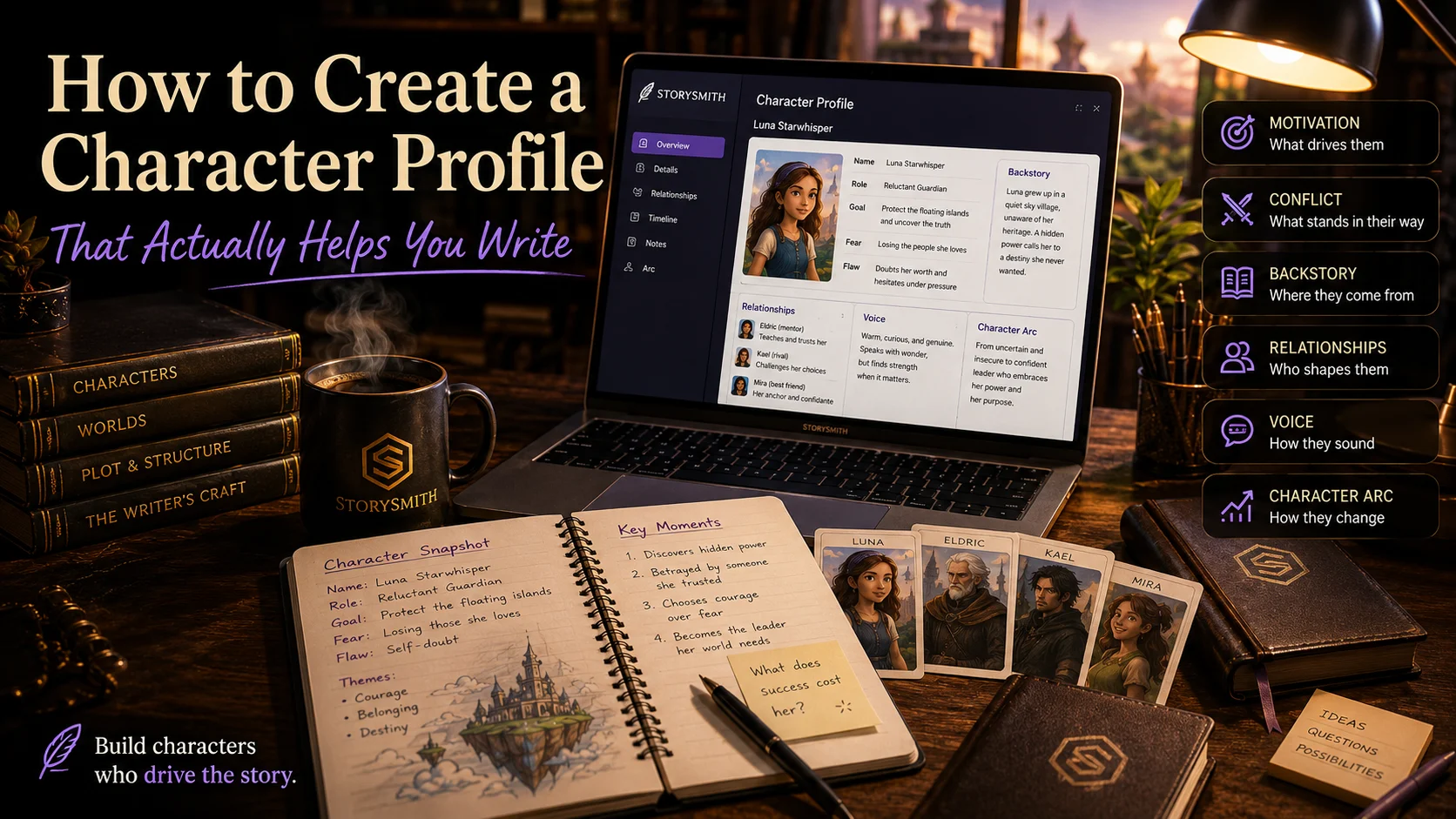
StorySmith was built around the idea that characters should be more than names buried in a notes document.
Writers can create structured character profiles and keep those characters connected to the larger creative project.
Characters can exist alongside:
- stories
- worlds
- locations
- maps
- timelines
- story notes
- chapter notes
- manuscript writing
That makes it easier to reference the people in your story while you are actually writing them.
StorySmith can also help writers visualize characters and use Quill, its AI writing coach, to explore ideas, brainstorm possibilities, and work through character-development questions without taking authorship away from the writer.
The goal is not to have software decide who your character is.
The goal is to give you better tools for discovering them.
A good character profile answers one important question
At the end of the day, the real test of a character profile is not how much information it contains.
It is whether it helps when you sit down to write.
When your character reaches a difficult moment, can you understand what they would do?
When they enter a room, do you know what they notice?
When someone challenges them, do you understand why they react the way they do?
When they make a mistake, does it come from who they are rather than what the plot needs?
If the profile helps answer those questions, it is doing its job.
Final thoughts
Memorable characters are not memorable because readers know their favorite color.
They are memorable because they feel like people.
They want things.
They fear things.
They contradict themselves.
They make mistakes.
They love badly sometimes.
They misunderstand one another.
They change—or refuse to.
A useful character profile helps you understand those deeper forces so that when you begin writing scenes, you are not moving a fictional chess piece around the plot.
You are writing a person.
Build enough of the profile to understand them.
Then put them into the story.
Pressure them.
Challenge them.
Let them surprise you.
That is where character development truly begins.