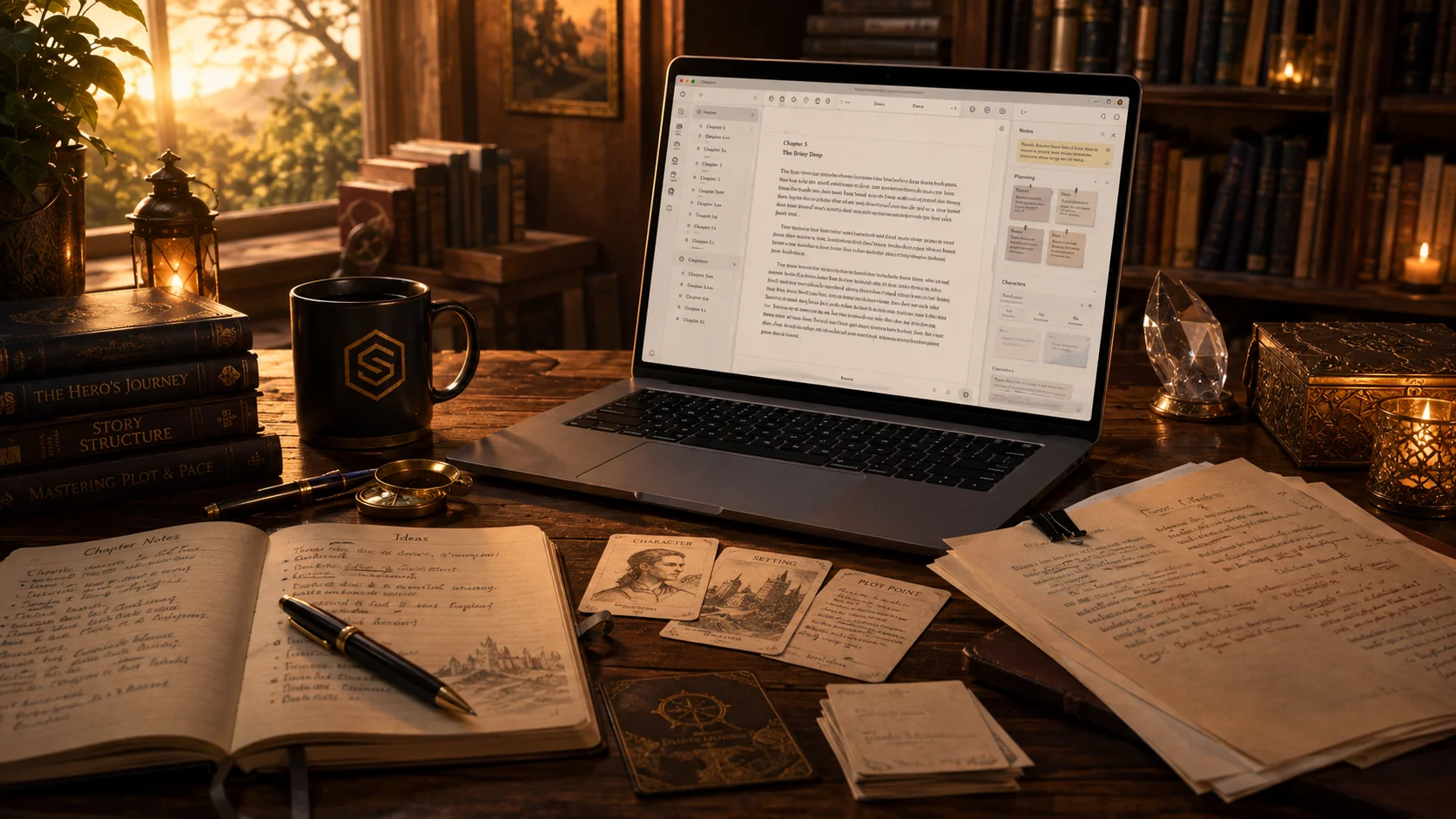
There has never been more writing software to choose from.
Authors can draft in traditional word processors, organize novels in dedicated writing apps, build elaborate story bibles, plot on digital boards, generate ideas with AI, collaborate online, and even format books for publication without leaving their computer.
More choices should make writing easier.
Instead, they can make choosing the right software surprisingly difficult.
Search for the best writing software for authors and you will find endless lists comparing applications by price, platform, and feature count. But a long checklist does not necessarily tell you whether a tool will actually make writing your book easier.
The better question is:
What should good writing software actually help an author do?
Whether you are writing your first novel or your tenth, these are 10 features worth paying attention to before choosing the writing platform where your story will live.
1. A writing environment built for long projects
Almost any text editor can hold a few paragraphs.
Writing a book is different.
A novel may contain dozens of chapters, hundreds of scenes, tens of thousands of words, revisions, notes, discarded ideas, and multiple drafts. As the manuscript grows, the ability to move around that project easily becomes increasingly important.
Good book writing software should let you:
- organize chapters clearly
- navigate between sections quickly
- keep related material close to the manuscript
- revise without losing your place
- track your progress as the book grows
A blank page is necessary.
But for a long-form writer, it should be only the beginning.
2. Manuscript organization that reduces friction
One of the biggest differences between a standard word processor and dedicated writing software is organization.
Many authors know the experience of having files named something like:
- Chapter-7-final.docx
- Chapter-7-final-revised.docx
- Chapter-7-actually-final.docx
- Notes-new.docx
- Character-notes-2.docx
That system may work temporarily, but the larger a project becomes, the more energy goes into managing the project instead of writing it.
The best writing software for authors should give a manuscript an understandable structure.
That might include:
- stories
- chapters
- scenes
- notes
- outlines
- reference material
- revision tools
- progress tracking
The goal is not complexity for its own sake.
The goal is to make it easy to know where everything belongs.
3. Character development tools
Characters rarely remain as simple as they seemed when a story first began.
A protagonist who starts as a name and a basic personality may eventually have:
- a detailed history
- physical characteristics
- motivations
- fears
- relationships
- secrets
- conflicts
- personal goals
- changing loyalties
- a character arc stretching across an entire novel
Keeping all of that consistent matters.
Strong writing software should make it possible to build character profiles that remain available while you write.
For fiction writers especially, this can prevent continuity problems and reduce the need to search through old chapters just to remember whether a character has green eyes, blue eyes, or a scar you mentioned 40,000 words ago.
Even better, character information should connect naturally to the story rather than living in an isolated database you rarely open.
4. Worldbuilding and location management
Not every writer is creating a sprawling fantasy kingdom, but almost every story has a world.
A romance may take place in a fictional town.
A mystery might revolve around several important locations.
A historical novel may require careful records of real places and customs.
A science-fiction story might span planets.
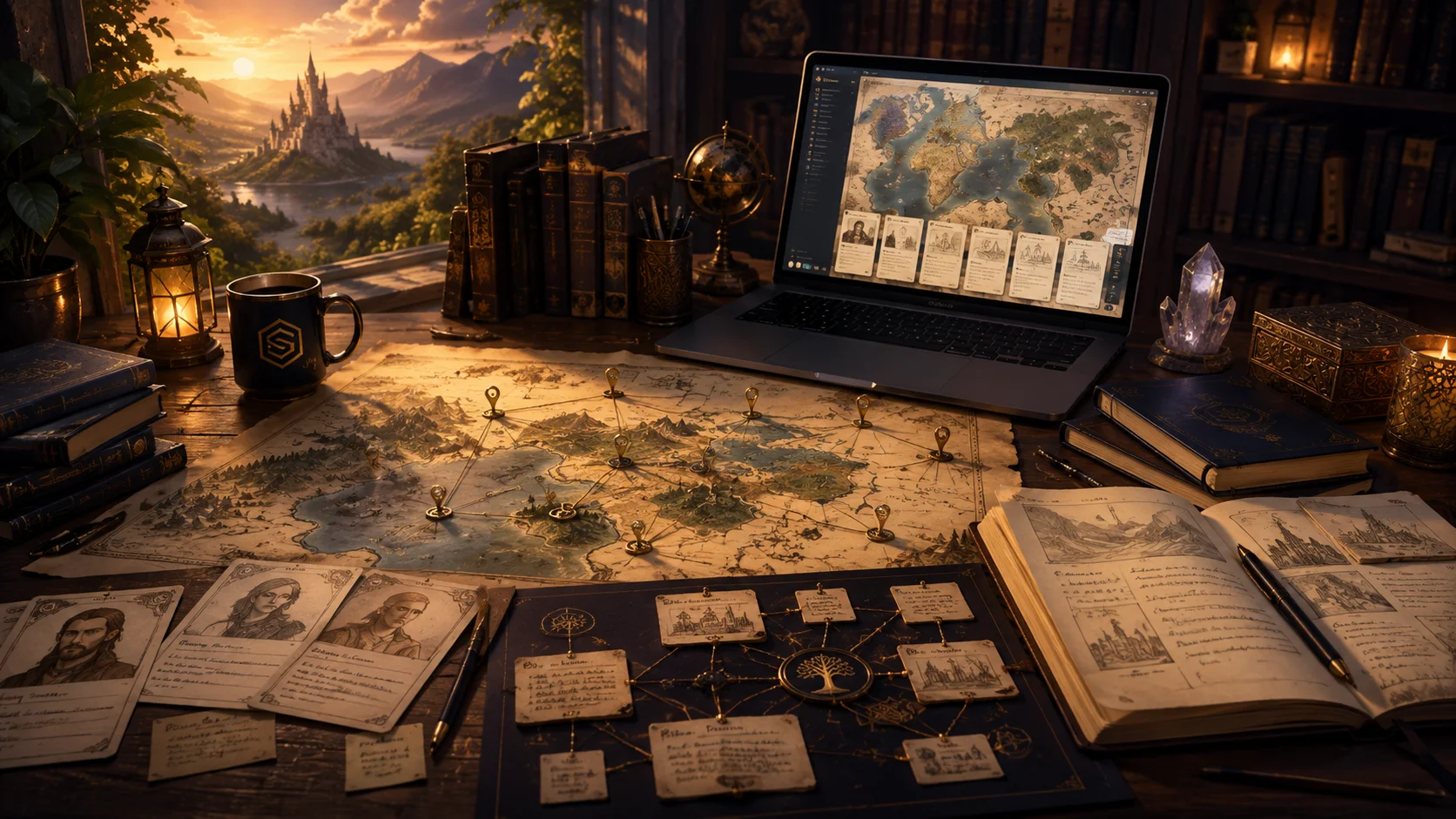
Worldbuilding software becomes particularly valuable when it allows writers to organize:
- worlds
- regions
- locations
- cultures
- history
- lore
- political systems
- magic or technology
- important setting details
The more complex your story becomes, the more useful it is to have this material connected to the manuscript itself.
Writers should not have to choose between a good drafting tool and a good worldbuilding tool if their creative process depends on both.
5. Story planning that works with your process
There is no single correct way to plan a book.
Some writers create detailed outlines before drafting the first sentence.
Others discover the story while they write.
Many fall somewhere in between.
Good novel writing software should accommodate that flexibility rather than forcing every writer into the same method.
Useful planning tools might include:
- visual story maps
- plot outlines
- scene organization
- event tracking
- character arcs
- story beats
- timelines
The key is that these tools should support the writer rather than become homework.
A plotting system that takes longer to maintain than the manuscript itself has stopped being useful.
The best writing tools help you see the shape of your story when you need that perspective and get out of the way when you are ready to write.
6. Timeline and continuity tools
Stories exist in time, even when the reader never sees a formal timeline.
Characters age.
Journeys take days.
Events happen in a particular order.
Seasons change.
One decision causes another event later.
When those details become inconsistent, readers notice.
Timeline tools can help authors track:
- important story events
- character milestones
- historical events
- overlapping plotlines
- travel
- time between scenes
- backstory
This becomes especially useful for series, complex fantasy stories, mysteries, historical fiction, and novels with multiple perspectives.
You may not need a timeline for every project.
But when you do need one, having it connected to your writing environment can save a tremendous amount of work.
7. Notes that stay connected to the writing
Every writer takes notes.
The problem is usually not creating them.
It is finding them later.
A thought about chapter twelve gets written into a phone.
A character idea goes into a notebook.
A plot fix gets dropped into a random document.
Three months later, you remember having the idea but cannot remember where you put it.
Good writing software should give you obvious places to store both project-wide notes and notes connected to specific parts of the manuscript.
Ideally, you should be able to keep:
- chapter notes
- story notes
- revision reminders
- research
- unresolved questions
- ideas for later scenes
close enough to the manuscript that they remain useful.
Your creative workspace should reduce the number of places you have to search for your own ideas.
8. AI that assists the writer instead of replacing the writer
Artificial intelligence has changed writing software dramatically.
That does not mean every author wants AI writing their book.
There is an important difference between software that says:
“I will write this story for you.”
and software that says:
“How can I help you write this story?”
For many authors, the second approach is far more useful.
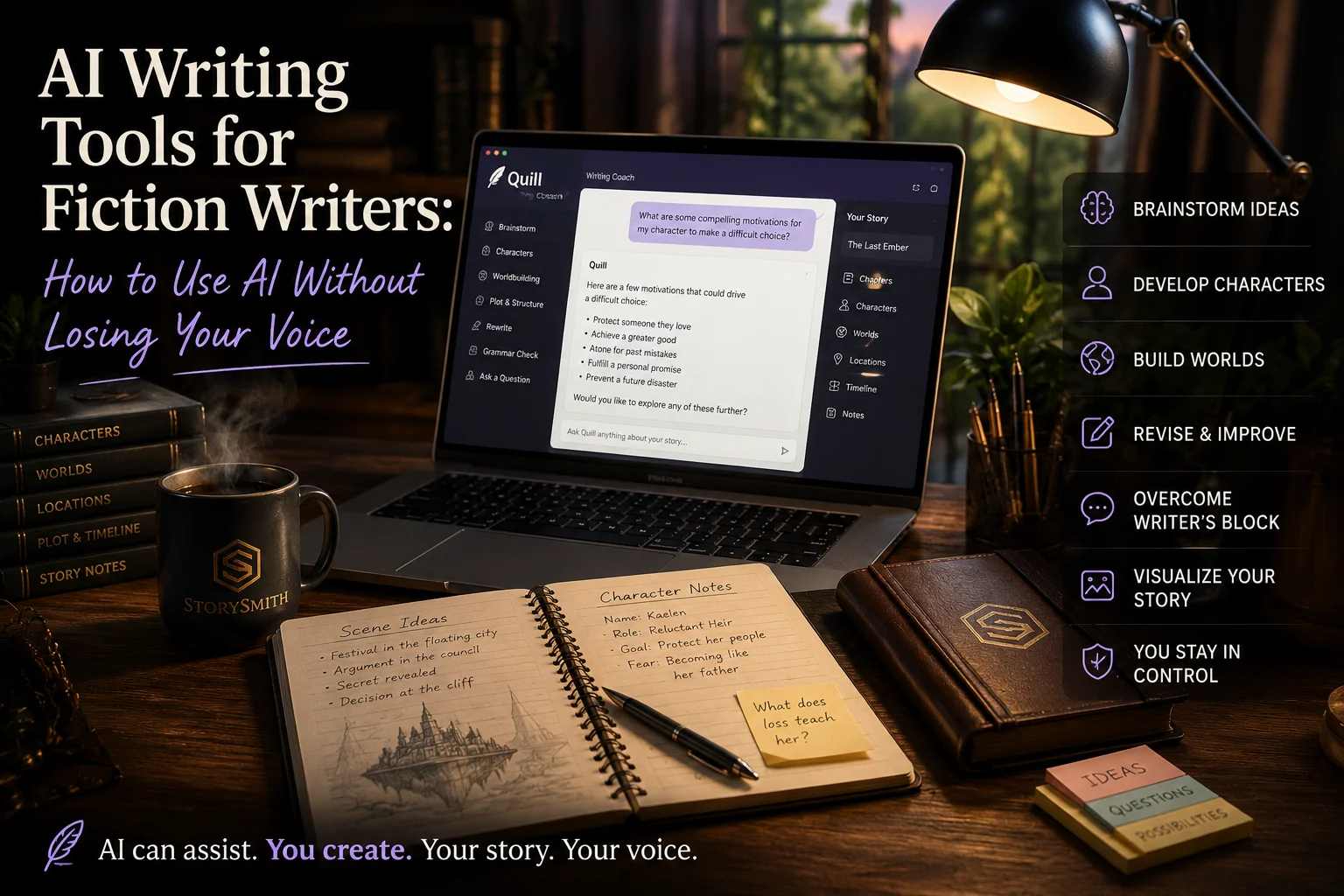
AI can serve as a creative assistant for tasks such as:
- brainstorming possibilities
- working through writer's block
- developing characters
- exploring worldbuilding ideas
- reviewing grammar
- suggesting alternative phrasing
- helping clarify a confusing passage
- asking useful questions about a scene
- generating visual inspiration
But the writer should remain in control.
Suggestions should be suggestions.
Changes should be deliberate.
The author's voice should remain the author's voice.
When evaluating AI writing software, look beyond whether a platform simply has AI. Ask what role that AI is designed to play.
The philosophy behind the feature matters just as much as the feature itself.
9. Collaboration when you need it
Writing can be solitary, but creating a book does not always stay that way.
Co-authors may work on the same project.
A trusted collaborator may help develop scenes.
Writing partners may review material.
Some projects involve people who need to understand the characters, locations, world, and story context rather than simply receiving a single exported document.
That makes collaboration an increasingly useful feature in modern writing software.
If collaboration matters to you, consider whether a platform allows other people to work with the project while preserving clear ownership and control.
The best collaboration tools should make teamwork easier without turning your manuscript into chaos.
10. Export and publication tools
Eventually, your manuscript needs to leave the writing environment.
Maybe you are sending it to an editor.
Maybe you want a Word document.
Maybe you need a PDF.
Maybe you are preparing a print edition.
Maybe you are publishing through a platform such as Amazon KDP.
This is one area writers sometimes overlook when choosing software early in the process.
Before committing months or years of work to a platform, find out what happens when your book is finished.
Useful capabilities can include:
- DOCX export
- PDF export
- print-ready layouts
- chapter formatting
- trim-size options
- typography controls
- manuscript preparation
- publication-ready output
Writing and publishing are different stages, but reducing the friction between them can make the entire process much easier.
The feature most lists forget: connection
Each feature above can be useful on its own.
But there is another question worth asking:
Do these tools actually work together?
Imagine a writing setup where:
- your manuscript is in one app
- your character profiles are in another
- your worldbuilding is in another
- your map is somewhere else
- your timeline is a spreadsheet
- your notes are in a phone
- your AI assistant opens in another browser tab
- your publishing software begins only after everything else is done
Technically, you have every feature you need.
Practically, you have eight different systems.
That fragmentation creates friction.
One of the most valuable things modern writing software can offer is not simply more features, but connection between those features.
Characters should relate to stories.
Locations should relate to worlds.
Events should relate to timelines.
Notes should relate to chapters.
Planning should support drafting.
Drafting should flow toward publication.
When those pieces live together, the software starts functioning as a creative workspace rather than a collection of unrelated utilities.
So what is the best writing software for authors?
There is no universal answer.
The best writing software is the one that removes the obstacles from your writing process.
A writer working on straightforward nonfiction may need something completely different from an author building a seven-book fantasy series.
Before choosing a platform, ask yourself:
- Am I primarily looking for a better place to draft?
- Do I need help organizing a large manuscript?
- Do I create detailed characters and worlds?
- Will I use maps or timelines?
- Do I want integrated story planning?
- Do I want AI assistance?
- Do I need collaboration?
- How important is export and publication formatting?
- How many different applications am I currently using to manage one book?
Your answers matter more than which product appears first on somebody else's ranking.
Where StorySmith fits in
StorySmith was built around a simple idea:
A story is more than a document.
The manuscript matters, but so do the characters who inhabit it, the worlds they live in, the locations they visit, the events that shape them, and the ideas the writer is still developing.
That is why StorySmith brings those pieces into one connected creative workspace.
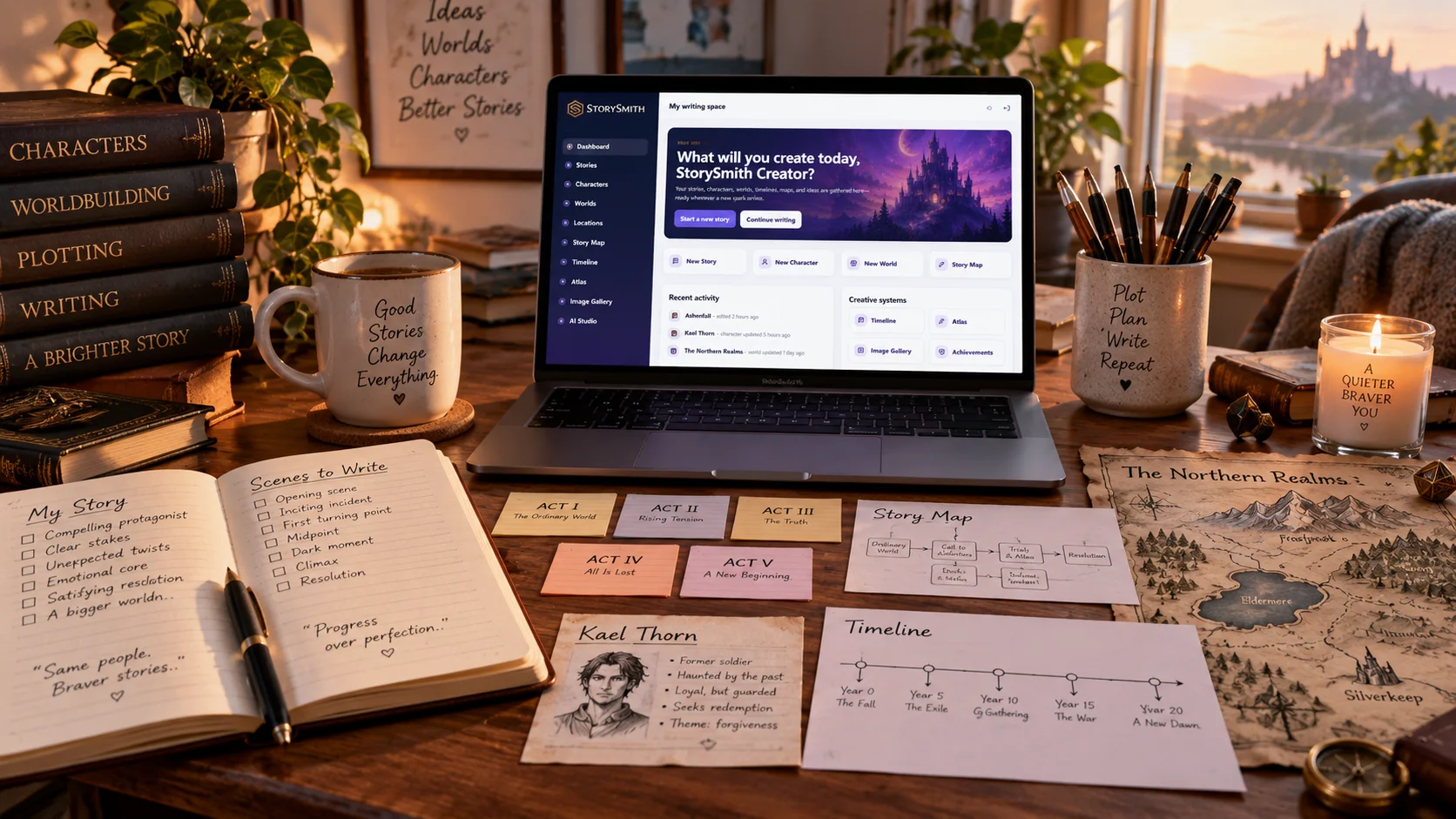
Writers can draft and organize chapters, develop detailed characters, create worlds and locations, work with maps and timelines, keep story and chapter notes, plan visually, and use thoughtful AI assistance without handing authorship over to the software.
StorySmith also includes tools for bringing creative ideas to life visually and preparing finished work for export and publication.
The goal is not to make the computer the storyteller.
The goal is to give the storyteller a better workshop.
The writer should remain the author
Technology is becoming increasingly capable of generating content.
That makes one question more important than ever:
What do we want writing software to help us become?
A better consumer of generated words?
Or a better writer?
Writing software is most valuable when it removes unnecessary friction while leaving imagination, judgment, voice, and creativity where they belong—with the person telling the story.
The right tool should help you keep track of the complicated parts.
It should help you develop ideas.
It should help you see connections you might otherwise lose.
It should make the journey from first idea to finished manuscript more manageable.
But the story should still be yours.
Final thoughts
The best writing software for authors in 2026 is not necessarily the platform with the longest feature list.
It is the one that helps you spend less time managing your writing and more time actually creating it.
Look for software that supports the full reality of writing a book: drafting, characters, worldbuilding, planning, continuity, notes, collaboration, creative assistance, and eventually publication.
And above all, look for a tool that fits the way you want to create.
If you are looking for one place to write your story, build the world around it, organize the pieces, and keep your own creative voice at the center of the process, StorySmith was built for exactly that journey.