AI writing tools are everywhere.
They can generate scenes, suggest plot twists, rewrite paragraphs, create characters, brainstorm settings, analyze prose, and produce thousands of words in seconds.
For fiction writers, that creates both an opportunity and a difficult question:
If AI can generate the words, where does the writer fit?
The answer depends largely on how you choose to use it.
There is a major difference between using artificial intelligence to support your creative process and asking it to become the creative process.
Used thoughtfully, AI can function like a brainstorming partner, writing coach, research assistant, or second set of eyes.
Used carelessly, it can flatten your voice, push your story toward predictable ideas, and gradually turn a deeply personal creative act into something that feels generic.
The goal should not be to see how much of your book AI can write for you.
A better question is:
How can AI help you become a better, more productive writer without taking the story away from you?
Why fiction writers are using AI
Writing fiction requires a surprising number of different skills.
You are not simply putting sentences on a page.
You may be:
- developing characters
- designing worlds
- solving plot problems
- researching unfamiliar subjects
- managing continuity
- refining dialogue
- revising prose
- checking grammar
- pacing scenes
- outlining chapters
- overcoming writer's block
AI can help with many of these tasks.
That is part of what makes AI writing tools so appealing.
Instead of staring at a problem alone, a writer can ask for another perspective almost instantly.
But the most useful role for AI is often not:
“Write this for me.”
It is:
“Help me think through this.”
That difference matters.
1. Use AI for brainstorming, not decision-making
Every writer eventually reaches a point where the next step is unclear.
Maybe your protagonist needs a believable reason to enter a dangerous place.
Maybe a chapter feels flat.
Maybe you need a political conflict for your fictional kingdom.
Maybe you know two story events need to connect but cannot figure out how.
These are excellent moments to use AI.
Instead of asking:
“What should happen next?”
try asking questions such as:
- What are five possible complications that could arise from this decision?
- What consequences might this character fail to anticipate?
- What are several reasons this alliance could collapse?
- What questions should I answer about this magic system?
- What might make this scene emotionally harder for the protagonist?
Notice what is happening.
The AI is producing possibilities.
You are still choosing the story.
That keeps the creative judgment where it belongs.
2. Let AI ask you questions
One of the most underrated uses of an AI writing assistant is turning the process around.
Instead of asking AI for answers, ask it for questions.
For example:
“Ask me ten questions that would help me understand this character better.”
Those questions might force you to think about:
- childhood
- fears
- contradictions
- relationships
- ambitions
- regrets
- values
- hidden motivations
The resulting character comes from your answers.
AI simply helped you explore more deeply.
The same method works for worldbuilding.
You might ask:
“What questions should I answer before creating the political system for this kingdom?”
or:
“What would a reader want to understand about how this technology affects everyday life?”
This type of AI assistance encourages creation instead of replacing it.
3. Use AI to work through writer's block
Writer's block does not always mean you lack ideas.
Sometimes you have too many.
Sometimes you know what should happen but cannot find the transition.
Sometimes a scene exists clearly in your imagination but refuses to cooperate on the page.
AI can help you diagnose the problem.
You might explain:
- what happened in the previous scene
- what needs to happen in the next scene
- what your character wants
- what feels wrong about the current version
Then ask:
“What might be causing this scene to feel stuck?”
That is different from:
“Write the scene.”
You remain responsible for the solution, but you gain another perspective on the problem.
Sometimes that is all you need to get moving again.
4. Use AI to deepen characters
Fiction becomes memorable when characters feel like people rather than collections of traits.
AI can help writers examine their characters from angles they may not have considered.
For example, you could ask:
- What contradictions might make this character more believable?
- What might this person secretly resent about their closest friend?
- What fear could conflict with this character's stated goal?
- How might this character behave differently under stress?
- What false belief might this character carry into the story?
You do not have to accept any suggestion.
In fact, some suggestions will probably be wrong for your character.
That can still be useful.
Sometimes knowing what a character would never do tells you almost as much as knowing what they would.
5. Use AI as a worldbuilding partner
Worldbuilding can expand almost endlessly.
A single idea about a kingdom can lead to questions about:
- government
- economics
- religion
- geography
- food
- transportation
- law
- warfare
- education
- social class
- magic
- technology
- history
AI can help writers identify gaps in a fictional world.
Suppose you create a city where magic is common.
You might ask:
“If healing magic were widely available in this society, what parts of everyday life would probably develop differently?”
That question could lead you toward medicine, insurance, law, warfare, population growth, religion, or social inequality.
The AI has not built the world.
It has helped you think through the consequences of the world you created.
That is a much more powerful use of the technology.
6. Use AI to examine plot logic
Writers spend so much time inside their stories that obvious gaps can become surprisingly difficult to see.
AI can act as an outside reader.
You can provide a summary of a plotline and ask:
- Where does the character's motivation seem weakest?
- What questions might a reader have at this point?
- Is there an obvious solution the characters appear to be ignoring?
- Which events may need stronger cause-and-effect connections?
- Where might this plot rely too heavily on coincidence?
You are not asking AI to replace your plot.
You are asking it to challenge the one you already created.
That distinction turns AI into a useful diagnostic tool.
7. Use AI during revision
Revision is one of the areas where AI can be particularly useful because the writer has already made the creative decisions.
You have the scene.
You know what happens.
You know what the characters are trying to do.
Now you are improving how effectively the scene communicates those choices.
AI can help identify:
- awkward sentences
- repeated words
- confusing passages
- inconsistent tense
- unnecessary repetition
- weak transitions
- unclear dialogue
- pacing problems
It can also explain why something may not be working.
That can be more valuable than simply receiving a rewritten paragraph.
If AI rewrites everything for you, you may fix the sentence without learning anything.
If it explains the problem, you can decide how to fix it yourself.
8. Be careful with AI rewriting
Rewriting tools can be useful, but this is also where writers can begin losing their voice without realizing it.
Imagine you write:
The rain had followed Daniel since Missouri, tapping against every motel window like it had something left to say.
You ask AI to “make it better.”
It provides something more polished.
So you replace your sentence.
Then you do it again.
And again.
Eventually hundreds of small creative choices have been replaced with choices made by the model.
The writing may still be technically competent.
But is it still recognizably yours?
Instead of simply requesting:
“Rewrite this.”
consider prompts like:
- Why does this sentence feel awkward?
- Give me three ways I could make this more concise.
- Which part of this paragraph is weakest?
- Does this dialogue sound natural?
- Where does the pacing slow down?
Use the response as guidance.
Then make the final choice yourself.
9. Protect the imperfections that make your voice yours
A writer's voice is not created by perfect grammar.
Voice comes from patterns of creative choice.
It includes:
- sentence rhythm
- vocabulary
- humor
- imagery
- pacing
- emotional restraint or intensity
- what you describe
- what you leave unsaid
Some of the things that make your writing distinct may technically be imperfections.
An unusually short sentence.
A fragment.
A strange metaphor.
A character who speaks in an unconventional rhythm.
If every sentence is repeatedly passed through a tool designed to make prose statistically smoother, those distinctive choices can slowly disappear.
Good writing is not the same thing as perfectly standardized writing.
Readers do not fall in love with mathematical averages.
They fall in love with voices.
10. Don't let AI eliminate creative struggle
This one may sound counterintuitive.
Struggle is part of writing.
Finding the right ending can be frustrating.
Working out a difficult character motivation can take days.
A chapter may need to be rewritten three times.
It would be convenient if technology could remove all of that difficulty.
But some of the best ideas appear because a writer was forced to wrestle with a problem.
Creative struggle causes us to make connections.
It forces us to understand our characters more deeply.
It makes us ask why.
If AI immediately resolves every difficult moment, writers risk losing the part of the process where some of their most original ideas emerge.
Use AI when it helps you move forward.
But do not assume every difficult creative problem needs to disappear instantly.
Sometimes the struggle is doing useful work.
11. Use AI to visualize your ideas
AI assistance does not have to mean generating prose.
Visual tools can also support fiction writing.
Being able to visualize:
- a character
- a location
- a fictional city
- a world
- an important object
- the atmosphere of a scene
can help writers refine what they imagined.
A generated image does not need to become published artwork.
It can function as creative reference material.
Seeing a character may make you reconsider their clothing, posture, age, or physical details.
Seeing a location may make you notice architectural or geographic questions you had not considered.
Visual AI can therefore become another brainstorming tool rather than a replacement for writing.
12. Keep your story information connected
AI becomes significantly more useful when it understands the context surrounding your story.
Generic prompts often produce generic answers.
If an assistant understands your:
- characters
- world
- locations
- plot
- notes
- timeline
- existing manuscript
then its suggestions can be grounded in the story you are actually writing.
This is one reason fiction-specific writing environments can be more useful than repeatedly explaining your entire novel to a generic chatbot.
Context matters.
A suggestion about your character should ideally be based on your character, not simply on common patterns found in thousands of other fictional characters.
The difference between an AI writer and an AI writing assistant
These phrases sound similar, but philosophically they can describe very different products.
An AI writer may be designed primarily to produce content.
You provide an instruction.
It provides writing.
An AI writing assistant can instead help a human writer think, revise, organize, explore, and solve problems.
Neither technology forces one particular workflow.
The important question for authors is what relationship they want with the tool.
Do you want to direct a system that produces a story?
Or do you want a system that helps you produce your story?
For writers who care deeply about authorship and creative voice, that distinction is worth thinking about before choosing AI writing software.
Questions to ask before choosing an AI writing tool
Before choosing an AI writing platform for fiction, consider asking:
- Does it encourage me to create or primarily encourage me to generate?
- Can I decide when AI is involved?
- Does it understand characters and story context?
- Can it help with brainstorming without automatically changing my work?
- Can I review suggestions before accepting them?
- Does it support revision and feedback?
- Can it help with worldbuilding?
- Does it support visual creativity?
- Will using it make my writing sound more like me or more like everyone else?
- Do I remain clearly in control of the finished work?
The most powerful AI is not necessarily the AI that generates the most words.
For a writer, the better tool may be the one that helps generate better ideas.
Where StorySmith fits
StorySmith was designed around the belief that technology should help people create rather than simply create for them.
That philosophy shapes how AI fits into the writing experience.
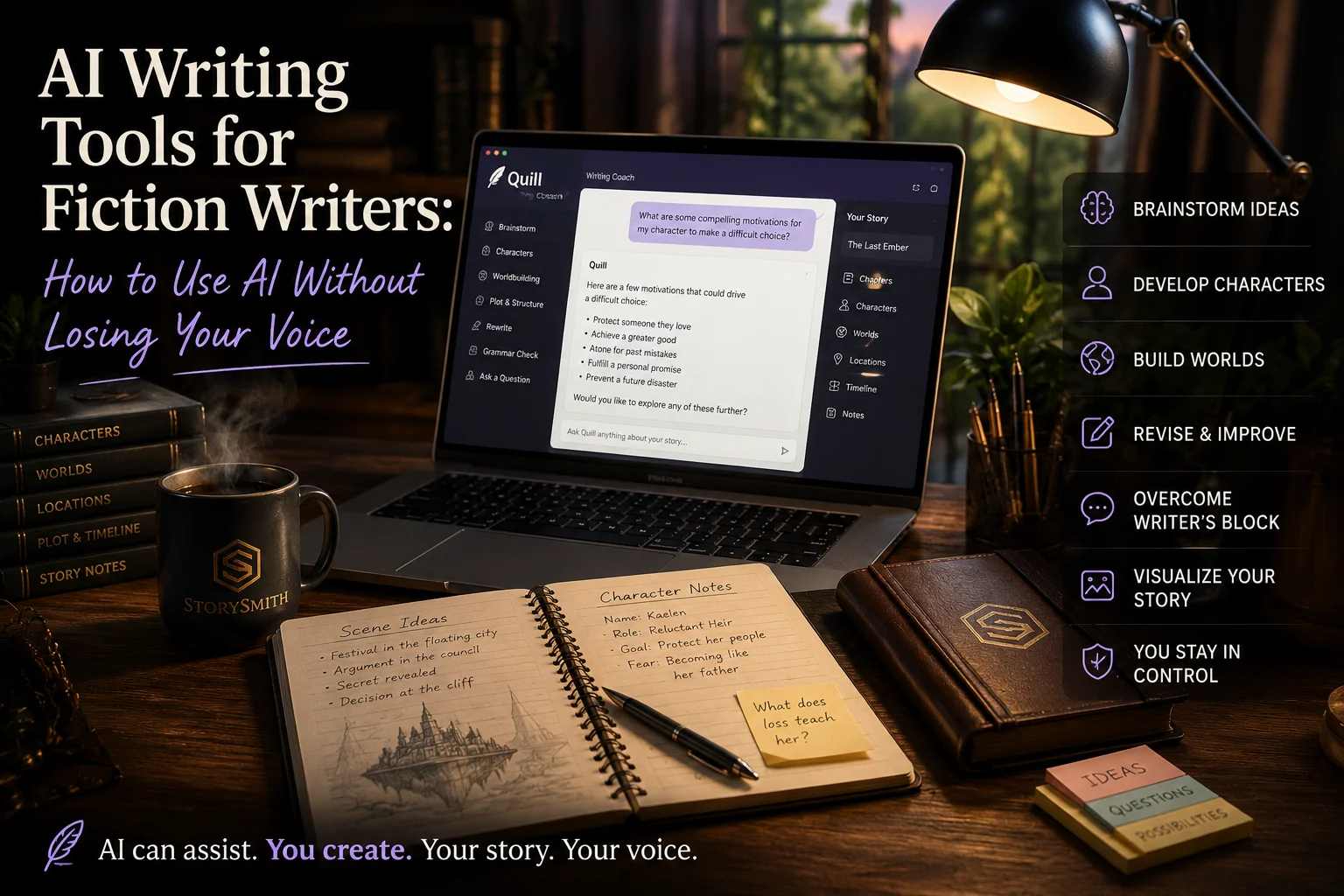
Writers can use Quill, StorySmith's writing coach, to help brainstorm ideas, work through creative problems, develop characters and worlds, review writing, explore alternatives, and get help when they are stuck.
StorySmith also connects that assistance with the broader creative project.
Characters, worlds, locations, story planning, notes, timelines, maps, manuscript writing, and visual creation can exist inside the same workspace.
That means AI does not have to operate in a vacuum.
It can support a larger creative process in which the writer is still making the decisions.
StorySmith's goal is not to press a button and replace imagination.
It is to give imagination better tools.
The writer remains the author
That principle is simple, but increasingly important.
AI will continue getting better.
It will generate more convincing prose, better images, stronger suggestions, and increasingly complex creative material.
But technological capability does not determine how writers must use it.
We still get to decide what kind of creative relationship we want with our tools.
For some writers, AI may remain primarily an editing assistant.
For others, it may help with brainstorming, character development, worldbuilding, or overcoming writer's block.
There is room for many approaches.
What matters is that the writer understands where their own creative decisions end and the machine's begin.
If keeping your own voice matters to you, use AI intentionally.
Ask it questions.
Challenge your ideas.
Explore possibilities.
Get feedback.
Learn from it.
Then make the choice yourself.
Final thoughts
AI does not have to be the end of human creativity.
Used thoughtfully, it can become another tool in the creative workshop.
A novelist already uses dictionaries, editors, spellcheckers, research tools, writing software, notebooks, critique partners, and countless other resources.
AI can join that list.
But a hammer does not design the house.
A paintbrush does not decide what belongs on the canvas.
And writing software does not have to become the storyteller.
The technology can help.
The story should still come from you.